WHAT DOES IT MEAN ? NEUROLOGICAL VOCABULARY
 Updated 8/26
Dear nurses,
Dearnurses.com is no longer available.
New information and links have been added below.
New information and links have been added below.
Basal skull fracture - What is it?
A basal skull fracture is usually diagnosed by CAT scan.
It is very difficult to see on X-Ray. The image below,
shows what the patient with a basal skull may look like.
It is very difficult to see on X-Ray. The image below,
shows what the patient with a basal skull may look like.

Basal skull fracture
It is important to be able to identify the signs of a basal
skull fracture.The crack in the base of the skull may cause
CSF ( cerebrospinal fluid) to leak from the nose or ear.
A halo ring may appear on the pillow. Cranial nerves
may also be damaged.
skull fracture.The crack in the base of the skull may cause
CSF ( cerebrospinal fluid) to leak from the nose or ear.
A halo ring may appear on the pillow. Cranial nerves
may also be damaged.
For more helpful information, please click on the links:

Here are some examples of neurological vocabulary:
Q -What is the normal distance for testing visual acuity?
A- 14-20 feet away.
Q - What does stereognosis mean?
A- The ability to identify objects by touching.
Q - What part of the brain is responsible for balance
and coordination?
and coordination?
A- The cerebellum, which lies below the cerebrum.
Q- What does word salad mean?
A- A collection of words that have no real meaning.
A- A collection of words that have no real meaning.
Q- What is anisocoria?
A- Unequal pupils which occur in about 20% of the
population
population
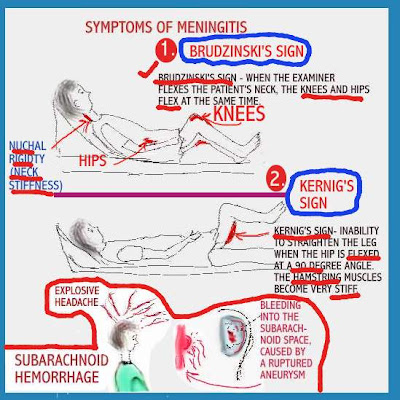
Brudzinski's and Kernig's signs are seen in patients
who have Meningitis or Subarachnoid hemorrhage.
who have Meningitis or Subarachnoid hemorrhage.
Brudzinski's sign -When the examiner flexes the patient's
neck, the knees and hips flex at the same time.
neck, the knees and hips flex at the same time.
Kernig's sign - inability to straighten the leg when the
hip is flexed at a 90 degree angle. The hamstring muscles
become very stiff.

Medical abbreviations - Part 2

Learn more about : Stroke and ICP Monitoring
Here are some diagnostic tests that are done frequently.
Follow the links below:
1. Chest X ray
2. CAT scan
3. EKG
4. MRI scan
5. Ultrasound
6. Echocardiogram
posted by Margaret at
9:14 AM


0 Comments:
Post a Comment
<< Home