STROKE- CRANIAL NERVE ASSESSMENT

Updated 1/26
Cranial nerve 5
The largest of the cranial nerves, is the Trigeminal.
This nerve contains three branches:
Opthalmic ( corneal blink reflex).
Maxillary - which supplies the upper jaw
Opthalmic ( corneal blink reflex).
Maxillary - which supplies the upper jaw
Mandibular - controls the lower jaw.
Cranial nerve 7 - is the facial nerve , this is
checked with the trigeminal nerve.
Learning for the layperson
Learn more about : The cranial nerves
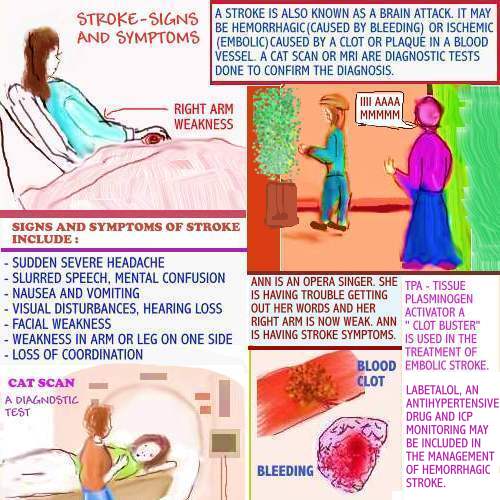
Scenario: In the image above, Ann is an opera
singer. While on stage, she suddenly starts having
trouble getting her words out. Her right arm also
feels weak. These symptoms are classic of someone
experiencing a stroke.
Signs and stroke symptoms:
- sudden , severe headache
- slurred speech, mental confusion
- slurred speech, mental confusion
- nausea and vomiting
- visual disturbances, hearing loss
- facial weakness
Enjoy the video: Anticoagulation therapy

Please watch the video: ICP monitoring

Poor circulation may occur for a number of reasons.
The patient in heart failure, is at risk for stroke.
The patient in heart failure, is at risk for stroke.
Myocardial infarction
A MI (myocardial infarction ) is also known as a heart
attack. It results from obstruction to blood flow. Fatty
deposits may cause this.
Death of the heart muscle surrounding the obstructed
blood vessel will result. Symptoms such as lack of oxygen,
shortness of breath and chest pain will occur.
TPA
TPA ( Thrombolytic Plasminogen Activator) is
a " clot buster" that is used in the treatment of
embolic stroke and myocardial infarction with
STEMI.
a " clot buster" that is used in the treatment of
embolic stroke and myocardial infarction with
STEMI.
TPA is not without its side effects. Bleeding,
posted by Margaret at
9:42 AM


0 Comments:
Post a Comment
<< Home