Dear Nurses

Tuesday, October 24, 2006

GLASGOW COMA SCALE


 Updated 6 /235

The Glasgow Coma Scale is a very important tool 
used to evaluate a patient's neurological status.

Please click on the links : 
New Nurse - Neurological Assessment and 
 Subarachnoid hemorrhage   for more helpful information:


Learn more : Critical thinking


The Glasgow Coma Scale is the commonly used
neurological assessment tool, in the clinical setting.
SEE above.


Learn more about: Stroke and ICP monitoring

NEUROLOGICAL ASSESSMENT

Updated 6/25

Dear nurses,

Stroke Assessment in the Clinical Setting is no longer available.
New information and links have been added below.


Please click on the link for more updated information:


Learn more about: Stroke and prevention


Learn more about: Neurological assessment


Learn more about: Cranial nerves


Friday, October 13, 2006

THE BRAIN LOBES


The human brain and quiz
The human brain is made up of two
cerebral hemispheres (right and left).
Each hemisphere has 4 lobes: frontal,
parietal, temporal and occipital.

The meningeal coverings are three
protective coverings around the brain.
Learn more, by clicking on the link below: 
ICP monitoring


BLOOD TRANSFUSION REACTION

Updated 2/25
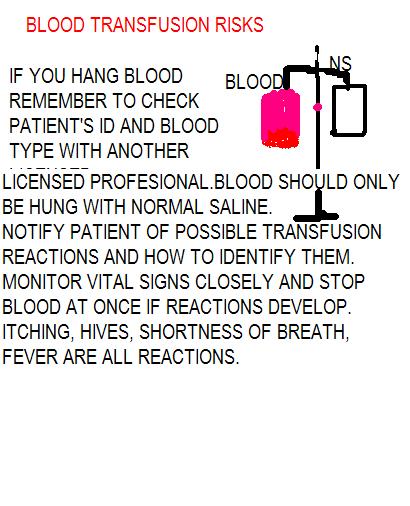
Possible signs of blood transfusion reaction:
Anxiety, chills, flushing, itching, shortness of breath
and chest pain.


A blood transfusion may be fatal. It is important
to make every attempt to check for any prior history
of blood transfusion reaction. 

Helpful hint: Discuss with the patient what kind of
reaction is possible and how to call for help. Always
follow your Institution's policies and procedures /MD
orders.Learn more:


Learn more about: MRI

BLOOD TRANSFUSION REACTION

Dear nurses,
Updated 8/23
New and helpful information on blood transfusion can be accessed by 
clicking on the, links below:


Learn more aboutClinical judgement,
see below.


           Clinical judgement


Wednesday, October 11, 2006

QUICK QUESTION ABOUT INFECTION CONTROL


Updated 12/24

Dear nurses,

Dearnurses.net is no longer available.

What do you do if the trash can in your patient's
room is overflowing ? If you continue to put trash
on the floor then you have just made your own
contribution to spreading infection.
Helpful hint:
- Try getting in touch with Housekeeping for help .


How does infection spread? Infection may spread
in many ways. Colds and flu's result from a weakened
 Immune system. The handling of food and poor hand
washing techniques may encourage the spread of infection.


Friday, October 06, 2006

CHANGING ROLES

   Dearnurses.net is no longer available.

Updated 12/25

Dear Nurses,

Have you ever considered what it feels like to be a patient?
I had a very bad bout of altitude sickness whilst visiting the
mountains, some weeks ago.

The feeling of helplessness was the worst thing I have ever felt.
It has certainly reminded me of how patients feel in the hospital.
Please try to empathize with patients and families and give it your best!
Good communication is important!


The standards of care are an essential part of  the
Nursing profession. It provides guidelines within a
framework of practices.
Learn more about : The standards of care


The standards of care are an essential part of  the
Nursing profession. It provides guidelines within a
framework of practices.

Learn more about : Nursing communication


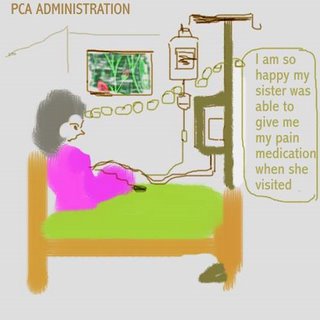
PCA ( Patient Controlled Analgesia)

Patient Controlled Analgesia may be ordered by
the doctor for the patient who is awake, alert and
able to self medicate. This method of administering
pain medication , is done via a pump, through the
intravenous route. Dosages are decided by the doctor.

However, patient and family teaching should be
included in the care plan. It is not uncommon for
family members to press the pain button for the
patient. Sessions 12 gives an overview of pain
assessment.

Indications for the use of the PCA pump include:
- patients who have surgical intervention
- patients with cancer or chronic pain issues
- conditions such as pancreatitis, sickle cell 
  anemia and more.


The Numerical Pain Scale is a useful tool when
assessing pain. It is based on a scale of 0-10.
A ladder starts from the ground and escalates to|
the highest point, so does pain start from 0-10.

It is important to do a pain assessment after pain
medication has been given. See image for more
information.