Dear Nurses

Sunday, May 01, 2011

HELPFUL TOPICS ABOUT THE STROKE PATIENT


Updated 5/25


Scenario : In the image a waitress is busy at work. 
She suddenly develops stroke symptoms. 

What is a stroke?
stroke is also known as a brain attack. It may be hemorrhagic
( caused by bleeding) or ischemic ( embolic), caused by a clot 
or plaque.

Can a stroke be prevented?
It is suggested that a stroke can be prevented. People who
smoke frequently, eat a diet rich in cholesterol foods and
do not exercise regularly, are considered to be at risk.

High blood pressure and obesity also puts someone at risk.
Lifestyle changes such as regular exercise, eating a diet with
fresh fruits and vegetables, as well as high fiber may help to
reduce stroke risk.


Reperfusion Therapy and its uses

Reperfusion Therapy is a form of treatment that
is used for patients who have a myocardial infarction
(MI) with STEMI. Typically, the patient with a
completely blocked coronary artery, would
demonstrate STEMI on the EKG.

TPA ( Thrombolytic Plasminogen Activator)
is not only used for reperfusion in patients
who had a myocardial infarction, it is also
used in the treatment of embolic strokes.


Learn more about: The Nursing Process


STROKE SYMPTOMS AND MORE

Dearnurses.net is no longer available.

Updated 8/26

Scenario : In the image a waitress is busy at work. 
She suddenly develops stroke symptoms. 

What is a stroke?
A stroke is also known as a brain attack. It may be hemorrhagic
( caused by bleeding) or ischemic ( embolic), caused by a clot 
or plaque.

Can a stroke be prevented?
It is suggested that a stroke can be prevented. People who
smoke frequently, eat a diet rich in cholesterol foods and
do not exercise regularly, are considered to be at risk.

High blood pressure and obesity also puts someone at risk.
Lifestyle changes such as regular exercise, eating a diet with
fresh fruits and vegetables, as well as high fiber may help to
reduce stroke risk.

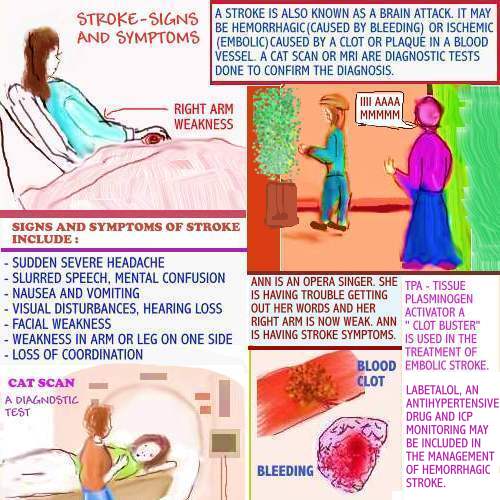
Signs and  symptoms of a stroke:
- sudden , severe headache
- slurred speech, mental confusion
- nausea and vomiting
- visual disturbances, hearing loss
- facial weakness
- weakness in arm or leg on one side
A CAT scan or MRI or both may be done to 
confirm diagnosis.


Learn more about :Subarachnoid hemorrhage


Learn more about : Abdominal Aortic Aneurysm


Learn more about: ICP MONITORING for the layperson


Learn more about: The Aging Process

Therapy whether physical, occupational or speech
is sometimes necessary to complete the healing
process. Learn more by clicking on the link:


WHAT IS A STROKE ?


Updated 5/24
Dear nurses,

What is it ? is no longer available.

What is a stroke?
stroke is also known as a brain attack. 

Identifying strokes and treatment

A stroke may be hemorrhagic (caused by bleeding) or
ischemic (embolic) caused by a clot or plaque in a blood
vessel. 

Bleeding ( hemorrhagic) into the brain may be caused
by trauma or rupture of a blood vessel due to high
blood pressure. ICP monitoring may be necessary for 
the patient with a hemorrhagic stroke.

In the case of an embolic stroke, a blood clot may
obstruct the flow of blood in the brain. This will also
affect oxygen to the brain.

Embolic strokes are usually treated with drugs such
as TPA ( Tissue Plasminogenic Activator). Antihypertensive
drugs and anti- seizure medications may also be ordered.


TPA ( Thrombolytic Plasminogen Activator)
is not only used for reperfusion in patients
who had a myocardial infarction, it is also
used in the treatment of embolic strokes.


Can a stroke be prevented?
It is suggested that a stroke can be prevented. People who
smoke frequently, eat a diet rich in cholesterol foods and
do not exercise regularly, are considered to be at risk.

High blood pressure and obesity also puts someone at risk.
Lifestyle changes such as regular exercise, eating a diet with
fresh fruits and vegetables, as well as high fiber may help to
reduce stroke risk.


In the image above, Ann is an opera singer.
While on stage, she suddenly starts having
trouble getting her words out. Her right arm
also feels weak. These symptoms are classic
of stroke symptoms.

Severe headache, mental confusion, visual
disturbances and right or left sided weakness
may also occur.

Learn more : Stroke assessment