Dear Nurses

Wednesday, March 24, 2010

NURSES, DID YOU KNOW THAT - PNEUMONIA CAN BE FATAL?

Updated 2/26

Dear nurses,

Pneumonia may occur following surgical intervention.
This is defined as postoperative pneumonia. But, there
is another type of pneumonia.

Aspiration pneumonia may occur in the patient on 
Enteral feeding. Both types of pneumonia are equally
fatal. Topics and links are below.
Also enjoy the video on : Dysphagia


Scenario: The image above is an example of a patient
who had surgery  and refuses to cooperate with breathing
exercises. She is now beginning to display the signs  and
symptoms of postoperative pneumonia. 
This topic continues : Here


Learn more about: Aspiration pneumonia


Scenario: Above, the image displays a patient who is in heart
failure and also has anasarca.

Learn more about : The Braden Scale 

Tuesday, March 23, 2010

MATH SOLUTIONS FOR NURSES

Updated 8/25
Dear nurses,

The above Chapter is no longer available.


In the image above, Lynn is a new graduate who
is full of expectation. She arrives early on her new
unit. But her hopes are shattered when her preceptor,
suggested that she is too busy to do an orientation.
Learn more, by clicking on the link:Critical thinking

CLINICAL INFORMATION FOR NURSES

Updated 3/26

Dear nurses,

Dearnurses.net is no longer available. 
New information has been added below.


The care plan for each patient, is a reflection
of the information provided about the history 
and MD's diagnosis. Learn more: Care plan

Homan's sign - when dorsiflexion of the 
   foot is done by the examiner, the 
patient 
   will complain of calf pain, if there is a
   blood clot.


The standards of care are an essential part of  the
Nursing profession. It provides guidelines within a
framework of practices.
Learn more about : The standards of care

Learn more about : Nursing communication


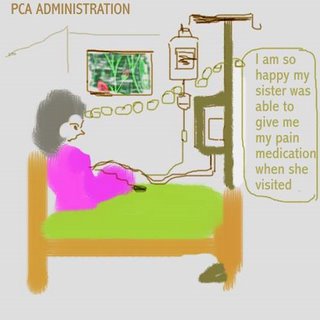
PCA ( Patient Controlled Analgesia)

Patient Controlled Analgesia may be ordered by
the doctor for the patient who is awake, alert and
able to self medicate. This method of administering
pain medication , is done via a pump, through the
intravenous route. Dosages are decided by the doctor.

However, patient and family teaching should be
included in the care plan. It is not uncommon for
family members to press the pain button for the
patient. Sessions 12 gives an overview of pain
assessment.

Indications for the use of the PCA pump include:
- patients who have surgical intervention
- patients with cancer or chronic pain issues
- conditions such as pancreatitis, sickle cell 
  anemia and more.


The Numerical Pain Scale is a useful tool when
assessing pain. It is based on a scale of 0-10.
A ladder starts from the ground and escalates to|
the highest point, so does pain start from 0-10.

It is important to do a pain assessment after pain
medication has been given. See image for more
information.