Dear Nurses

Friday, May 25, 2007

HAVE A GOOD MEMORIAL DAY

Updated 8/25


Have a good Memorial Day!


Here are some diagnostic tests that are done frequently.
Follow the links below:

1. Chest X ray
2. CAT scan
3. EKG
4. MRI scan
5. Ultrasound
6. Echocardiogram

Be cautious, prevent falls!


RECOGNIZING SAFE NURSING PRACTICES - WHAT IF YOU WERE LINDA?

Updated 8/25

Dear nurses,

It is important to recognize the importance 
of being a safe nurse. Linda's story continues :

Below, topics of interest
have been added. Enjoy learning!


Learn more about: Common causes of medication errors

`Learn more about: Critical thinking

LINDA CANNOT GO ON

Updated 8/25

Dear nurses,

Remember a bad decision impacts patients and staff!
Linda's story continues: Here


Learn more about : Organizational Skills


Learn more about : Communication skills

WHY LINDA WHY ?

Updated 11/24

Linda is responsible for the patients in her care. Making decisions 
using bad judgement, could ultimately impact a patient's outcome.

Learn more about: Here


Scenario 1: In the image above, the nurse in the green 
top has been enjoying a lengthy conversation with a friend. 
She has no idea one of the patients is having chest pain.

The doctor arrives to confront the situation. It is important 
for the nurse in a clinical area to be vigilant and use good
clinical judgement. Monitoring of the patients in the ER, 
is a priority.

This topic continues here.

Learn more about : Neurological assessment

WHAT IF YOU WERE IN YOUR COWORKER'S SITUATION?


Updated 8/25

Dear nurses,
New topics have been added below.
Enjoy Learning!


Dear nurses,

Regardless of where a nurse works, good
communication is of utmost importance

How good are your communication skills?
Have you helped your coworker today?
Have a good week.


Learn more about: Triage

Learn more about : Critical thinking


Learn more about : Neurological assessment

HAVE A HEART LINDA !

Linda's story starts : Here
Updated 3/26

Dear nurses,

New information has been added below.
Enjoy learning!


The standards of care are an essential part of  the
Nursing profession. It provides guidelines within a
framework of practices.
Learn more about : The standards of care

Learn more about : Nursing communication

It takes "all hands on deck" to complete the work.

It is important to recognize that classroom skills
are different from clinical skills. A nurse's
performance in the work place takes on a different 
challenge from the classroom.

Learn more about: Hemodynamic Monitoring and

Saturday, May 19, 2007

HAVE A GREAT WEEK- ENJOY LEARNING MORE

Updated 3/26
Dear nurses,
Enjoy learning more

It takes "all hands on deck" to complete the work.

It is important to recognize that classroom skills
are different from clinical skills. A nurse's
performance in the work place takes on a different 
challenge from the classroom.

Learn more about: Hemodynamic Monitoring and


What does TBI mean ?

This means Traumatic Brain Injury. 
In the image below, a surfer hits his head on the pier.
He sustains a TBI and a Subarachnoid hemorrhage.


He was admitted to the ICU for treatment. An EVD was
placed by the doctor. Please click on the links for more
helpful information:


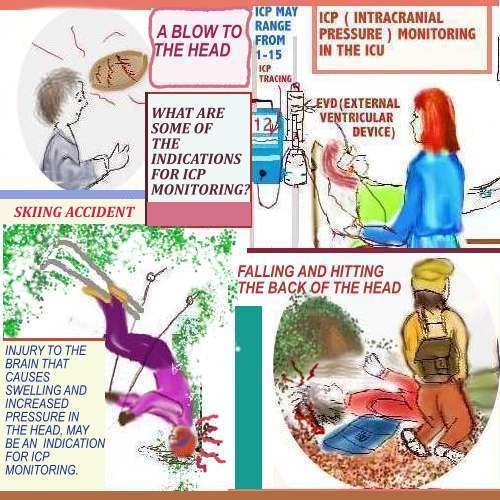
In the above image, examples of how brain injuries
can occur, are shown. Click on the links:
ICP monitoring
for more information.

Scenario: Nick is a 21 year old male, who was on his way 
to work , when he became involved in a head on collision.
Someone called 911 and paramedics arrived on scene, to
resuscitate him.

Learn more about : Sepsis


In the image above, there are people taking a stroll
in the park. Although no one stops to think about 
each action that is taken, muscles, bones and joint
are at work.

The human body is made up of muscles, bones and 
joints of different sizes. Bones and joints have very
important work to do. They work in unity, to provide
support for the body, as well as protecting vital 
organs.

Learn more about: Muscles, bones and joints


HOPE YOU HAD A GOOD WEEK


Hi guys,


Hope you had a good week.

A CHF CASE STUDY

A patient in Congestive Heart Failure may become very anxious. Cardiac assessment, lab values and EKGs are all part of the management. Mechanical ventilation Chapter 8)may be necessary. For the complete CHF Case study, just click on the link:

http://dearnurses.com/congestive_heart_failure_chf_case_study


CHF CAUSES SHORTNESS OF BREATH


To learn more about Congestive Heart failure (CHF) and Myocardial Infarction(heart attack), simply click on the link:http://www.dearnurses.com/home

CHF IS RESOLVED

Dear nurses,
Updated 3/24

Dearnurses.com / CHF Case study is no longer available. Please click
on the links below, for more updated information:
Do you know your heart

WHAT HAPPENS IN CHF


Damage to the heart like Myocardial Infarction may cause CHF.
The EKG will show changes.Enjoy reading and learning more about CHF.
Simply click on the link:

CLINICAL ASSESSMENT OF CHF


To learn more about Congestive Heart Failure(CHF), simply click on the link:
and enjoy learning.

Saturday, May 12, 2007

HAPPY MOTHER'S DAY

Happy mother's day to all moms and enjoy learning more about the Clinical Setting.

WHAT IF YOUR PATIENT HAD AN ILEUS

Updated 5/25


A paralytic ileus may develop, after surgical intervention. 
Enjoy watching the video : Bowel obstruction


Paralytic ileus is a postoperative complication. It may occur in any 
post surgical patient. It is caused by anesthetics.

What are some of the symptoms of this condition?
Absent bowel sounds, abdominal pain and distention.

It is important to check for bowel sounds in the postoperative period.
Documentation is also important. 
If there are no bowel sounds, MD should be notified for further orders.

The doctor orders tests such as X-Ray and CT scan  to confirm diagnosis. 
Insertion of a nasogastric tube is also ordered by MD .

PARALYTIC ILEUS


Paralytic ileus is a postoperative complication. It may occur in any 
post surgical patient. It is caused by anesthetics.

What are some of the symptoms of this condition?
Absent bowel sounds, abdominal pain and distention.

It is important to check for bowel sounds in the postoperative period.
Documentation is also important. 
If there are no bowel sounds, MD should be notified for further orders.

The doctor orders tests such as X-Ray and CT scan  to confirm diagnosis. 
Insertion of a nasogastric tube is also ordered by MD .


PARALYTIC ILEUS


A paralytic ileus is a postoperative complication.
It may occur in any surgical patient and is caused
by anesthetics.

Absent bowel sounds, abdominal pain and distention
usually occur. Learn more about this topic by clicking 
on the link: Bowel obstruction.


Scenario: Alice had surgical intervention and developed
a paralytic ileus. Her doctor ordered insertion of a naso-
gastric tube to suction , IV fluids and correction of electrolytes 
if necessary. 

Her nurse shares what the doctor ordered to help relieve 
the abdominal discomfort. Her progress will be monitored 
and documented.

Saturday, May 05, 2007

HOW GOOD ARE YOUR BLOOD PRESSURE TECHNIQUES?

Dear nurses,
Updated 8/23

Regardless of how long we have been nurses, there is always something more 
we can learn about the clinical setting. 
For more on blood pressure click on the link: 
Helpful information
Enjoy reading.

WHAT IF YOUR PATIENT IS IN ARDS (Adult Respiratory Distress Syndrome)?


To learn more about ARDS (Adult Respiratory Distress Syndrome) and how to recognize it in the clinical setting, simply click on the link:
(Chapters 5 and 14 )and enjoy reading.

TOM IS CARED FOR IN ICU - ARDS

 Updated 4/24
Dear nurses,

Dearnurses.com is no longer available.
Please click on the link: ARDS
for more updated information.


To learn more about the treatment of ARDS in the ICU setting, simply click on the link:
Chapter 14 (A Day in the ICU) and enjoy reading.

LUNGS IN ARDS (Adult Respiratory Distress Syndrome)

Updated 7/25


ARDS ( Adult Respiratory Distress Syndrome) is
identified as a condition in which the lung tissue
becomes stiff and oxygenation is difficult.

The air sacs ( alveoli) fill with fluid and white
 patches are seen on X-Ray.

Mechanical ventilation becomes necessary to
assist the workload of breathing. Breath sounds
are decreased, as ventilation of lung tissue
becomes difficult.

Learn more about:


ARDS usually accompanies some other illness.
Trauma, pancreatitis, pneumonia, and massive
blood transfusion account for reasons ARDS
may occur.


 Most people who anticipate taking a long plane
 flight, may hardly stop to think about dehydration
 and its consequences. 
Learn more about : DVT and Diagnostic tests


TOM RECOVERS FROM ARDS


Updated 5/24
Dear nurses,

Dear nurses.net is no longer available. Please click on
the link: What is ARDS
for more updated information.


Recovery from ARDS may be a long and complicated process. Mechanical ventilation,(video Sessions 44)
sedation, NMB and Respiratory treatments are generally used in the ICU care of these patients.
To learn more about this topic, simply click on the link:
http://www.dearnurses.net/the_clinical_setting_step_by_step
Chapter 14(( A day in the ICU) and enjoy reading.