Dear Nurses

Friday, August 31, 2007

SEPTIC SHOCK (COLD PHASE )


Dear nurses,
Updated 3/24

Dearnurses.com / Case study is no longer available.
New information has been added. Please click on
the link below: 


Scenario: Nick is a 21 year old male, who was on his way 
to work , when he became involved in a head on collision.
Someone called 911 and paramedics arrived on scene, to
resuscitate him.

Sepsis continues: Here


SEPTIC SHOCK (COLD PHASE)

Updated 6/25
Dear nurses,
Dearnurses.net is no longer available.
Please refer to the information below for updated links.


The management of septic shock in the (Hypodynamic phase)
 is very complex. ICU monitoring is necessary. Altered mental
 status, fever, chills, renal failure and ARDS, are some of the
 complications of cold phase sepsis.
Learn more by watching the video:
(Sessions 10)


Learn more about: Sepsis


Learn more about : Organizational skills

The New Nurse- Blood transfusion

What is Multiple Sclerosis?

Multiple Sclerosis is a very debilitating illness
which affects the Central Nervous System. It is
considered to be an autoimmune disease and
progresses over a period of time.

What are some symptoms of Multiple Sclerosis?
- Arm and/or leg weakness
- Visual disturbances like diplopia (double vision)
- Ataxia (unsteady gait)
- Tremors
- Fatigue

See image above for treatment.
Enjoy the video: Multiple sclerosis


Learn more about : Anticoagulation Therapy and
Enjoy the video: Anticoagulation therapy

Learn more about: The Circulatory System


SEPTIC SHOCK ( COLD PHASE)

Updated 1/24
The information above has been updated. Dearnurses.com is
no longer available. For current information, please click on
the link : Septic Shock


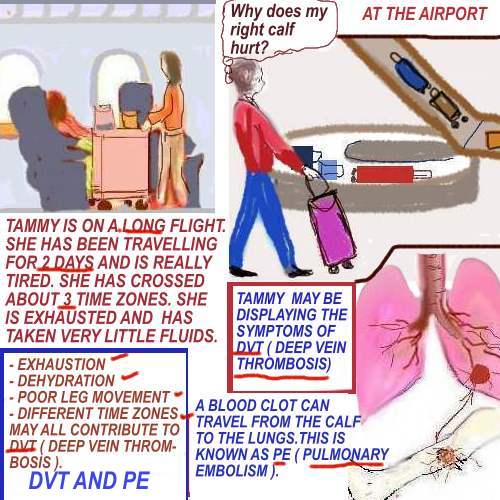
Learn more about : ARDS, DVT and PE

Friday, August 24, 2007

SEPTIC SHOCK ( WARM PHASE)


Updated 7/26
Dear nurses, 

Dearnurses.com is no longer available.
Below, new links for a case study have
been added.
Have a good week!


Scenario: Nick is a 21 year old male, who was on his way 
to work , when he became involved in a head on collision.
Someone called 911 and paramedics arrived on scene, to
resuscitate him.

Links below:


Aortic rupture may occur as a result of trauma.
Shortness of breath, chest or upper back pain
are some of the symptoms.

Cardiac Tamponade may be caused by penetrating 
trauma such as a knife wound. Pericardiocentesis
is usually done to remove the blood in the pericardial
sac. Learn more, by clicking on the links below:
 Nursing Fundamentals-Part3


SEPTIC SHOCK CASE STUDY

Updated 2/26


The above case study is no longer available.Below
new information about a case study on Sepsis is 
available.

Learn more about : Sepsis


The surgical patient is at risk for infection, related to
  surgical intervention.
Paralytic ileus may occur .
- Hypothermia due to fluid loss and bodily exposure
  during surgery. Hypothermia increases the body's need
  for oxygen and possibly may lead to a cardiac event.
 Warming measures are necessary.


SEPTIC SHOCK CASE STUDY

Updated 2/24
Dear nurses,
There is more updated information on this topic at :

Septic shock is divided into two stages. A warm phase
 known as the Hyperdynamic phase (above shows the
 clinical picture of the warm phase) and a cold phase
 known as the Hypodynamic phase. 


Scenario: Nick is a 21 year old male, who was on his way 
to work , when he became involved in a head on collision.
Someone called 911 and paramedics arrived on scene, to
resuscitate him.

SEPTIC SHOCK

 Updated 4/24
 Dear nurses,

Dear nurses.com is no longer available. Please click
on the link below, for more updated information:

Septic shock is a form of shock which has two stages.
The warm phase, known as the hyperdynamic phase
and the cold, known as the hypodynamic phase.
To learn more you may watch the video:


Learn more about: The standards of care


Saturday, August 18, 2007

RETURN FROM VACATION

Updated 5/25

Dear nurses,

Vacation is long over, but there is still a lot of learning to do.
See below!


Above is a 35 year old female who has been
having problems after a divorce. Alcohol
ingestion in large quantities has become a
way of coping.

Learn more about : Autodigestion


Scenario : In the image a waitress is busy at work. 
She suddenly develops stroke symptoms. 

Learn more about: Stroke and its prevention

SEPTIC SHOCK

Updated 7/25
Dear nurses,

Please click on the link below, for more updated information:

Septic shock is a form of shock which has two stages.
The warm phase, known as the hyperdynamic phase
and the cold, known as the hypodynamic phase.
To learn more you may watch the video:


Here are some diagnostic tests that are done frequently.

Follow the links below:

1. Chest X ray
2. CAT scan
3. EKG
4. MRI scan
5. Ultrasound
6. Echocardiogram

Falls should be avoided at all cost!

CLINICAL SKILLS OF A NURSE

Updated 10 /25
Dear nurses,

The Clinical Setting step by step is no longer available.
This has been replaced with new topics and links.


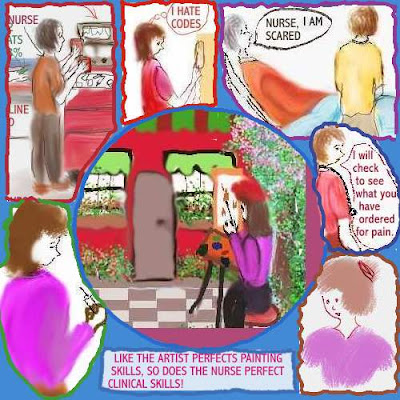
Like the artist perfects painting skills, so does the nurse perfect clinical skills.

Learn more about : Critical thinking


Learn more about: Triage