DEFIBRILLATION AND ITS CONSEQUENCES

Updated 8/26
Scenario: A Code Blue is in progress in the Emergency Room.
The medical staff have gathered around the bedside to assist.
Unfortunately, the nurse on the left got distracted . She begins
to move the paddles towards the nurse on the right.
The medical staff have gathered around the bedside to assist.
Unfortunately, the nurse on the left got distracted . She begins
to move the paddles towards the nurse on the right.
How could this happen? It is easy to make a mistake when there
is so much goingon in a confined space. It is important to follow
all the security guidelines for a Code Blue, like making sure no
one is close to the bedside prior to defibrillation.
is so much goingon in a confined space. It is important to follow
all the security guidelines for a Code Blue, like making sure no
one is close to the bedside prior to defibrillation.
Hemodynamics and its meaning
Hemodynamics refers to blood flow.
The heart is a pump, which pumps blood around the body.
If there is damage, like a myocardial infarction, the heart's
function will be impaired.
Signs and symptoms include: chest pain,
shortness of breath and EKG changes.
If there is damage, like a myocardial infarction, the heart's
function will be impaired.
Signs and symptoms include: chest pain,
shortness of breath and EKG changes.

A cardiopulmonary arrest can happen anywhere.
In an ICU setting, trained staff members (ACLS)
are usually on hand when a Code Blue is called.
Learn more about this topic by clicking on the link:
Hemodynamic Monitoring
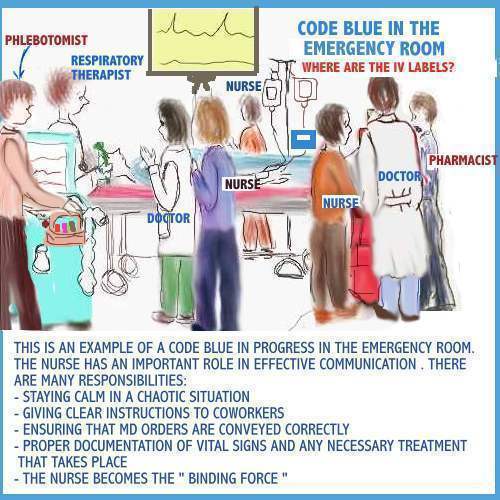
The image above shows a Code blue in progress. This is
happening in the Emergency Room. Always follow your
happening in the Emergency Room. Always follow your
Institution's policies and procedures for Code Blue.
What is the role of the nurse who is assigned to the Code Blue?
The nurse has an important role in effective communication.
There are many responsibilities.
There are many responsibilities.
- staying calm in a chaotic situation
- giving clear instructions to coworkers
- ensuring that MD orders are conveyed correctly
- giving clear instructions to coworkers
- ensuring that MD orders are conveyed correctly
- proper documentation of vital signs and all treatments /
interventions that take place ( defibrillation for example)
- the nurse becomes the " binding force
interventions that take place ( defibrillation for example)
- the nurse becomes the " binding force
Addressing lethal rhythms
There are some EKG rhythms that are considered to be lethal.
Immediate intervention is necessary for good outcomes. Here are
the most lethal rhythms:
the most lethal rhythms:
Asystole - sometimes referred to as " flat-line. The electrical
heart's conduction system is not functioning. There are no
ventricular contractions. The patient is pulseless and
unresponsive.
heart's conduction system is not functioning. There are no
ventricular contractions. The patient is pulseless and
unresponsive.
Ventricular Tachycardia - There may or may not be a pulse
present. The ventricles are beating rapidly and there is no atrial
activity. Blood flow to the vital organs is compromised.
present. The ventricles are beating rapidly and there is no atrial
activity. Blood flow to the vital organs is compromised.
Ventricular Fibrillation - There is a chaotic rhythm and no
atrial activity. The ventricles are quivering , so there is no
cardiac output. There is no pulse and the patient may become
unresponsive. Immediate action to defibrillate is usually done.
atrial activity. The ventricles are quivering , so there is no
cardiac output. There is no pulse and the patient may become
unresponsive. Immediate action to defibrillate is usually done.
***American Heart Association has protocols in place for each
EKG rhythm.
EKG rhythm.


posted by Margaret at
10:16 AM
|
0 comments