Dear Nurses

Friday, January 30, 2009

PATIENT ASSESSMENT

Dearnurses.com is no longer available.
New topics with links have been added below.
Patient assessment is a very important tool. 
The patient having chest pain, would have 
an assessment done by the nurse.

A description of the pain, as well as pain
scales assessment ( 1-10) is usually done.
Documentation of intervention is also 
necessary. 
Below are more assessment links:
 Neurological assessment
Abdominal assessment 


Learn more about: 

An intravenous infusion may be started in a peripheral
site or a central line site.

Learn more by clicking on the link:
IV assessment


ASPIRATION PNEUMONIA

Aspiration pneumonia can be avoided. If the patient has a compromised airway, like the stroke patient, or one who is unconscious , a foreign substance such as stomach content ( from tube feeding) or emesis (vomitus) may enter the lungs. You may also enjoy watching the video:
http://www.dearnurses.com/clinical_nursing_videos_called_sessions
(Sessions 14).

Sunday, January 25, 2009

ASSESSMENT FROM HEAD TO TOE

Updated 12/25
Dear nurses,
Dearnurses.com is no longer available.
New information has been added below.


A skiing accident and admission to ICU

In the image above, a skiing accident has occurred.
The injured person  is admitted to the ICU. ICP
monitoring has been set up.

Learn more by clicking on the link:
Communication skills

Dearnurses.com is no longer available. Abdominal Aortic Aneutysm may result
from hypertension. A stroke may also result from hypertension.


Above two nurses are transporting a patient to the ER.
The nurse on the right has been using an AMBU bag to
 administer oxygen.There is no improvement in the
oxygen saturation.
Where does critical thinking come in?


Scenario: John was admitted to the ICU with
difficulty breathing.He was intubated and placed
on mechanical ventilation.

PATIENT ASSESSMENT IS IMPORTANT

Updated 8/25


Scenario: Mrs. R is a 48 year-old female who has a history
of a previous myocardial infarction. She was admitted 2 days
ago with mild chest pain. She was resting comfortably when
she suddenly started feeling short of breath. She is anxious 
and calls the nurse.

What actions did the nurse take?
The nurse reassures Mrs. R. She does an assessment, vital 
signs and oxygen saturation. She gives oxygen per protocol.

-The nurse notifies the doctor of what has occurred and her
assessment findings. She also mentions the vital signs, low
oxygen saturation, and steps that were taken to correct the
saturation. The doctor gives further orders, including a
transfer to CCU.


Why chest pain assessment?
It must be remembered that a patient with heart damage
 will also experience chest pain. Assessment of the pain
should also be included. This may be sharp, with radiation
 to shoulder/jaw, or it may feel like chest pressure.

Helpful Hint:

Chest pain should always be assessed.
 Enjoy learning more about this topic by clicking on the link:
Simplifying Cardiogenic Shock


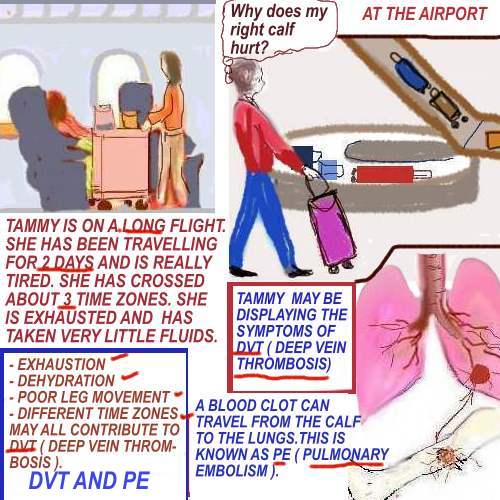
Learn more about : ARDS, DVT and PE


Thursday, January 15, 2009

EKG SERIES - WHAT IS WRONG WITH THIS EKG


Updated 6/25
Dear nurses,

Dearnurses.com is no longer available.

Below is more updated information.


Watch the video: Cardiac assessment


Learn more about : Triage

EKG SERIES- WHAT IS WRONG WITH THIS EKG

Updated 11/25

Dear nurses,
Dearnurses.com is no longer available.
New information has been added below.


Learn more about : Chest pain assessment

Helpful Hint:
Chest pain should always be assessed.
 Enjoy learning more about this topic by clicking on the link:
Simplifying Cardiogenic Shock


Learn more about : ARDS, DVT and PE


Hemodynamics refers to blood flow. The heart is a pump,
which pumps blood around the body. If there is damage, 
like a myocardial infarction, the heart's function will be 
impaired. 
Learn more about: Congestive heart failure


Learn more about : Abdominal Aortic Aneurysm


Sunday, January 04, 2009

THE CLINICAL SETTING STEP BY STEP

Updated 1/25             Dearnurses.net is no longer available.
Dear nurses,

Topics of interest with new links have been added below:

                                        Learn more about Code Blue


 Clinical scenarios are a normal part of nursing.
Above there are five clinical scenarios unfolding.

Scenario 1- A patient who is admitted to a healthcare
facility and will need teaching. Click on the link:
ER experience for the layperson

Scenario 2- The patient on mechanical ventilation
and the nurse is unsure what to do.
Click on the link:

Scenario 3 -A patient has arrived in the Emergency
Room, both the doctor and nurse are at the bedside
to do an assessment.
Learn more by clicking on the link:
Scenario 4 - A nurse does an assessment. 
IV assessment

Scenario 5 - A nurse tries to encourage a patient to do
breathing exercises.

VASOSPASM AFTER SUBARACHNOID HEMORRHAGE

Updated  2/26
Dear nurses,
Dearnurses.net is no longer available. Please click on the link:
for more updated information

Following a Subarachnoid hemorrhage, a patient may develop a
condition known as Vasospasm.The consequences may be very 
serious. This topic continues : Here

Learn more about : Care planning 

Learn more about : The cranial nerves

Learn more about : Nursing communication

Learn more aboutICP MONITORING for the layperson

HYPOVOLEMIC SHOCK IN THE ICU

Dearnurses.net is no longer available.

Updated 4/26

In the image above, Tim fell and has sustained 
a femur fracture. This may cause massive blood
loss and possibly hypovolemic shock. More 
information is listed below.


Learn more about: Hypovolemic shock

CARDIOVERSION VS. DEFIBRILLATION

 
Updated 10 /24

Cardioversion is a form of shock treatment
 sometimes used for Atrial Fibrillation. It is
used to change the heart rhythm from Atrial fibrillation
to a normal rhythm( sinus rhythm).The shock
is done on the R wave of the EKG. Typically,
it is not an emergency.

Defibrillation is a form of shock treatment
used for Ventricular fibrillation.This is a life 
threatening rhythm and the shock is done as
an emergency.There is usually no pulse and
 the patient is unresponsive.

To learn more about this topic, simply click
on the links below: Chest pain assessment and quiz


    Heart and lungs work together.


Learn more about this topic by watching the video:


Learn more about: Mitral valve regurgitation


WHEN CPR IS NEEDED IN THE EMERGENCY ROOM

   Updated 8/25

Dearnurses.net is no longer available.

New information has been added below.


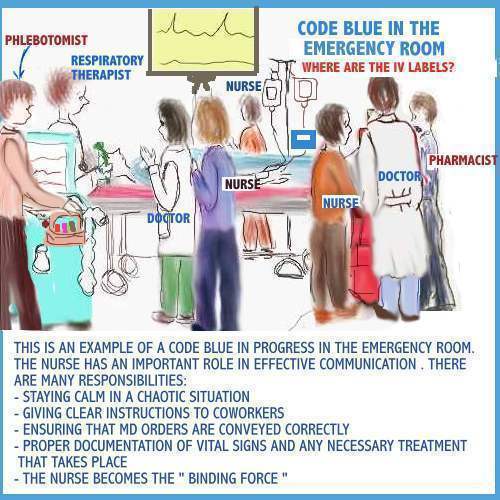
The image above shows a Code blue in progress. This is 
happening in the emergency Room. Always follow your
Institution's policies and procedures for Code Blue. 

The role of the nurse who is assigned to the Code Blue

The nurse has an important role in effective communication.
There are many responsibilities.
- staying calm in a chaotic situation
- giving clear instructions to coworkers
- ensuring that MD orders are conveyed correctly
- proper documentation of vital signs and all treatments /
  interventions that take place ( defibrillation for example)
  - the nurse becomes the " binding force.


Scenario: Mrs. R is a 48 year-old female who has a history
of a previous myocardial infarction. She was admitted 2 days
 ago with mild chest pain. She was resting comfortably when
she suddenly started feeling short of breath. She is anxious 
and calls the nurse.

What actions did the nurse take?
-The nurse reassures Mrs. R. She does an assessment, vital signs
, and oxygen saturation. She gives oxygen per protocol.

The nurse notifies the doctor of what has occurred and her
assessment findings. She also mentions the vital signs, low
oxygen saturation, and steps that were taken to correct the
saturation. The doctor gives further orders, including a
transfer to CCU.

Why chest pain assessment?
It must be remembered that a patient with heart damage
 will also experience chest pain. Assessment of the pain
should also be included. This may be sharp, with radiation
 to the shoulder/jaw, or it may feel like chest pressure.


Learn more about : ARDS, DVT and PE

CARDIOPULMONARY ARREST IN THE ICU

                          Dearnurses.net is no longer available.

Updated 1/25
Dear nurses, 
If you were floated to the ICU and the patient in your care was in
Cardiopulmonary arrest  , would you know what to to do?
 Even if you are not an ICU nurse, knowing how to get organized
is very important. Additional learning:
Cardiopulmonary arrest and quiz questions

IDENTIFYING ARDS IN THE ICU TRAUMA PATIENT

Updated 9/25

Scenario: The image above shows a patient in the ICU,
who was involved in a car accident. The vital signs shown
on the monitor, is an indication that something is wrong.

His heart rate is rapid, respirations are rapid and oxygen
saturation is decreasing. This patient may be displaying
 the early signs of ARDS.

It would be important for the nurse to document her findings
and notify the doctor for more intervention like lab values and
a chest x-ray. The patient's progress should also be reflected in
the Care plan.

IDENTIFYING ARDS

This complex illness, may be triggered by a number of conditions.
Causes include, but are not confined to:
- pneumonia , near drowning
- massive blood transfusions
- pancreatitis, trauma, sepsis

In Adult Respiratory Distress Syndrome ( ARDS), 
the lung tissue becomes very stiff and oxygenation 
is difficult. The air sacs ( alveoli) t
ypically, fill with
fluid and white patches are seen on X-Ray.


Learn more about : ARDS, DVT and PE
The term"white out" is sometimes used to describe
the damaged lungs. Mechanical ventilation becomes 
necessary, to assist with the workload of breathing. 
Breath sounds are decreased as ventilation of lung 
tissue becomes difficult.


Learn more about : Sepsis


Learn more about: Emergency Room for the layperson


SEPSIS IN THE ICU PATIENT


You may not be an ICU nurse, but you may never know when the opportunity to help out in the ICU may arise. Having a knowledge base and knowing what to look for, can be very useful and helpful to the patient. To learn more about this topic, simply click on the link :http://www.dearnurses.net/the_clinical_setting_step_by_step,(Chapter 14)

Thursday, January 01, 2009

NURSES PERFECT THEIR CLINICAL SKILLS

Dearnurses.com is no longer available.

Updated 1/26
Dear nurses,

Like the artist perfects painting skills, so does the
nurse perfect clinical skills. New topics have been
added below.

Clinical scenarios are a normal part of nursing.

Above there are five clinical scenarios unfolding.

Scenario 1- A patient who is admittCed to a healthcare
facility and will need teaching. Click on the link:

Scenario 2- The patient on mechanical ventilation
and the nurse is unsure what to do.Click on the link:

Scenario 3 -A patient has arrived in the Emergency
Room, both the doctor and nurse are at the bedside
to do an assessment. Learn more by clicking on the link:
Scenario 4 - A nurse does an assessment. Click on the links:

Scenario 5 - A nurse tries to encourage a patient to
do breathing exercises. Click on the link:

Learn more about : Diabetic education and
DKA ( Diabetic ketoacidosis


An intravenous infusion may be started in a peripheral
site or a central line site.

Learn more by clicking on the link:
IV assessment