Dear Nurses

Friday, October 29, 2010

WHAT IS NURSING DIAGNOSIS?

Dear nurses,

Updated 3/24
Dearnurses.net is no longer available. Please
click on the link:The nursing process
for more updated information.


A nurse who is new to the clinical setting, knows all
too well it is a challenge. Typically, a combination of
learning in the classroom and a clinical area is done.

Patient assessment is a very important tool. 
The patient having chest pain, would have 
an assessment done by the nurse.

A description of the pain, as well as pain
scales assessment ( 1-10) is usually done.
Documentation of intervention is also 
necessary. 
Below are more assessment links:
 Neurological assessment
Abdominal assessment 

HEMODYNAMICS - WHAT IS IT?

                                     Dearnurses.net is no longer available.
Updated 2/25
Dear nurses,


Hemodynamics and its meaning

Hemodynamics refers to blood flow.
 The heart is a pump, which pumps blood around the body.
 If there is damage, like a myocardial infarction, the heart's
 function will be impaired.

Signs and symptoms include: chest pain,
shortness of breath and EKG changes.

DIAGNOSTIC TESTS - PART 3

Learn more about the topics above by
 clicking on the link
Sessions 37

Updated 8/25


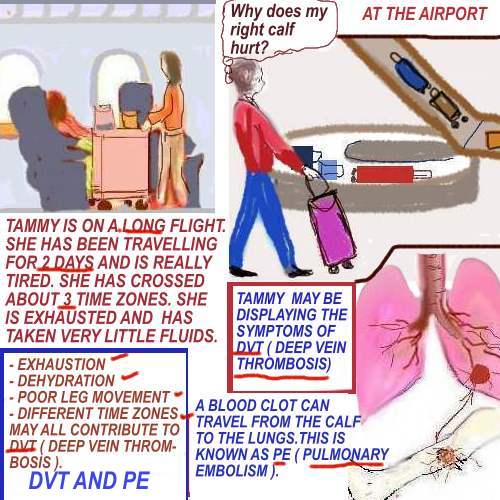
Learn more about : ARDS, DVT and PE


Clinical picture of the patient in Cardiogenic Shock


Learn more about: Chest pain and EKG 
                                               

Sunday, October 17, 2010

ANTIEPILEPTIC DRUGS AND MORE

Updated 5/26
Dear nurses,

Dearnurses.net is no longer available.
New topics and links have been added below.


Scenario : Celeste is a 32 year old female, who is
pregnant for the first time. She is preeclamptic and
 is receiving a Magnesium Sulfate infusion. 
Her assessment shows she is hard to arouse.
Learn more, by clicking on the link :
Preeclampsia


What is PROM ( Premature Rupture of Membranes) 

This condition which typically occurs in the third trimester of
pregnancy, is also called " water breaking". The amniotic sac
which contains the baby, may rupture prematurely and amniotic 
fluid leaks out of the vagina. 

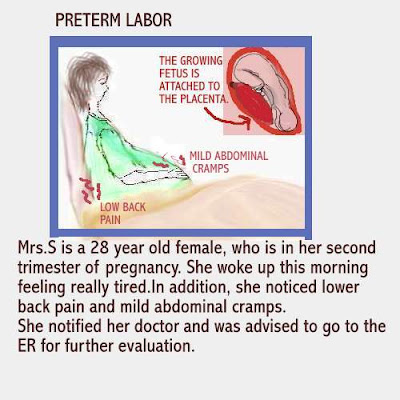
Scenario:  Mrs. S is a 28 year old who is in her second trimester of pregnancy.
She woke up feeling very tired. In addition, she noticed lower back pain and
mild abdominal cramps. She notified her doctor and was advised to go to the 
ER for further evaluation.
Learn more by clicking on the link:
Preterm labor

What is glioblastoma?

Gliobalstoma multiforme is a tumor. It can 
be treated through chemotherapy drugs like
Temozolmide (Temodar).

Side effects include: seizures, nausea, vomiting,
flu symptoms, and weight/hair loss.

Learn more by clicking on the link:
The New Nurse - Brain and spinal tumor


Learn more about: Multiple sclerosis

Learn more by clicking on the link:

In the image above, there are people taking a stroll
in the park. Although no one stops to think about 
each action that is taken, muscles, bones and joint
are at work.

The human body is made up of muscles, bones and 
joints of different sizes. Bones and joints have very
important work to do. They work in unity, to provide
support for the body, as well as protecting vital 
organs.

Learn more about: Muscles, bones and joints


Saturday, October 02, 2010

DIAGNOSTIC TESTS - PART 2

Updated 8/25

 Learn more about the topics listed above : Sessions 36 and Dysphagia


Learn more about:
ERCP 
(Cholangiopancreatography)


 Clinical scenarios are a normal part of nursing.
Above there are five clinical scenarios unfolding.

Scenario 1- A patient who is admitted to a healthcare
facility and will need teaching. Click on the link:
ER experience for the layperson

Scenario 2- The patient on mechanical ventilation
and the nurse is unsure what to do.
Click on the link:

Scenario 3 -A patient has arrived in the Emergency
Room, both the doctor and nurse are at the bedside
to do an assessment.
Learn more by clicking on the link:
Scenario 4 - A nurse does an assessment. 
IV assessment

Scenario 5 - A nurse tries to encourage a patient to do
breathing exercises.