Dear Nurses

Thursday, August 27, 2009

QUICK LEARNING FACTS - PART 2

Updated 9/25
Dear nurses,

Have a good week and enjoy my new posts below.
God bless you all.


The surgical patient is at risk for: hypothermia,
dehydration, postoperative pneumonia, DVT ,
paralytic ileus or a cardiac event.


 In the immediate postoperative period, a patient may
 develop 
pneumonia if breathing exercises are
neglected .The incentive 
spirometer is used
for this purpose.

The plan of care is used to reflect what is needed 
to improve patient progress. Abdominal assessment
for paralytic 
ileus is also important. 

This leads to abdominal distention and absent bowel
sounds. 
DVT ( deep vein thrombosis) can be avoided
by encouraging 
leg exercises, using TED hose or SCD
device on 
the patient confined to bed.

Learn more about: IV site care and assessment


Falls should be avoided at all cost!


Learn more about this topic by watching the video:


Learn more about: Mitral valve regurgitation


The image above, gives an indication of what 
happens to the patient in Congestive heart failure.

Causes include : Hypertension, myocardial infarction,
cardiomyopathy are some examples. See above image.


WHAT ROLE DOES THE PHYSICAL/OCCUPATIONAL THERAPIST PLAY

Updated 1/26             Dearnurses.net is no longer available.

Dear nurses,

New information and links have been added below.

Who needs Therapy?

Here are some examples of patients who need Therapy:

-The patient who had a traumatic event.
- The patient had surgical intervention such as hip surgery,
   limb amputation, or a fractured limb.
- A patient who suffered a stroke or other brain injury.
- A patient who had a spinal injury and needs 
  help to restore mobility.
- A person who is mentally unable to cope due to stress.
- A person who has a bipolar disorder, or Schizophrenia.
A person with PTSD or OCD 
Learn more about:
Why Therap
The Aging Process


Learn more about the: Cranial nerves 

Types of Therapy

Physical therapy targets restoration of gross motor 
movement, balance and strength. Occupational therapy
on the other hand, helps to restore fine motor skills like
feeding oneself, bathing, dressing and ultimately,
independence.

Speech therapy aims at the improvement of swallowing ,
speaking and communication.

In the image above, Mrs.M sustained a fracture of
the neck of the femur. An ORIF ( open reduction
internal fixation) was done in the Operating Room.

Above, an example of MD orders is shown. An 
abductor pillow to prevent internal rotation has
been put in place. 

The patient who is confined to bed is at risk for
skin breakdown, DVT and pneumonia. This should
be reflected in the plan of care.

Enjoy watching the video:
Stress and its impact on the body


MEDICATION ADMINISTRATION-THE FIVE RIGHTS

Updated 4/26

Dear nurses, 
New topics and links have been added below.


Learn more about : Medication Administration


Learn more about: Medication error

Common causes of medication errors


Like the artist perfects painting skills, so does the
nurse perfect clinical skills!

Friday, August 14, 2009

CENTRAL LINE AND IV SITE CARE

Updated 8//26

Dear nurses,
New information and links have been
added below.


An intravenous infusion may be started in a peripheral
Learn more by clicking on the link:


Learn more about the above topic by clicking on the link:
Chemo and BMT


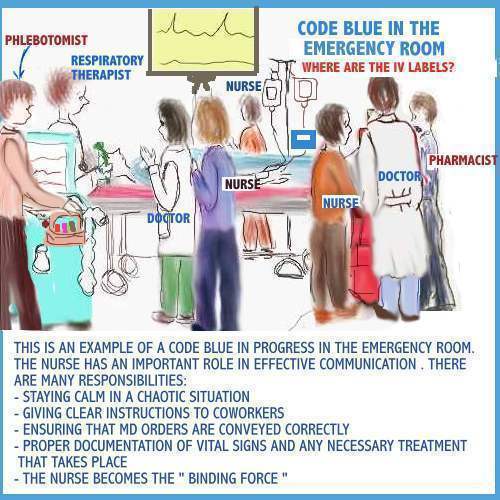
The image above shows a Code blue in progress. This is 
happening in the emergency Room. Always follow your
Institution's policies and procedures for Code Blue. 

The role of the nurse who is assigned to the Code Blue

The nurse has an important role in effective communication.
There are many responsibilities.
- staying calm in a chaotic situation
- giving clear instructions to coworkers
- ensuring that MD orders are conveyed correctly
- proper documentation of vital signs and all treatments /
  interventions that take place ( defibrillation for example)
  - the nurse becomes the " binding force.

IV SITE CARE, PREVENTING INFECTION

Updated 5/26


Dear nurses,


Learn more about: IV site assessment and care

NURSES, ENJOY YOUR PROFESSION

Updated 5/25
Dear nurses,


Tuesday, August 11, 2009

NEW NURSE - DO YOU KNOW HOW TO ORGANIZE YOUR DAY?

Updated 8/26

Dear nurses,
Dearnurses.com is no longer available.
New information has been added below.

A nurse's priorities

When a nurse's priorities are wrong

In the image above, Jenna is a new nurse.
She has not fully understood the importance
of safe nursing practices.

Her desperation to be on time to meet a friend
for lunch, took priority over patient safety.

Jenna works in the ICU. The monitor alarm 
of the patient in her care, was going off. She
made no attempt to check if something was
wrong.

It is important to understand that a patient who
is cared for in the ICU, requires a higher level
of care.

It is unfortunate Jenna did not prioritize.


   Helpful information for the clinical nurse


  In the image above, Lynn is a new graduate who
  is full of expectation. She arrives early on her new
  unit. But her hopes are shattered when her preceptor
  suggested that she is too busy to do an orientation.

It is unfortunate, but this does happen on occasion.
Although Lynn is off to a rough start, there are some
things she can do to make her situation easier.
Learn more by clicking on the links below:

    The role of the Preceptor 
A Preceptor has a very important role to play in
training new nurses. Typically, a nurse who is 
assigned to this role, has a significant number of
years of experience and is able to utilize the learned
skills in a meaningful way.

The role of a preceptor often impacts the way a new 
nurse sees the nursing profession and may even have
an effect on what is expected.


Learn more about : Organizational skills

It takes "all hands on deck" to complete the work.

It is important to recognize that classroom skills
are different from clinical skills. A nurse's
performance in the work place takes on a different 
challenge from the classroom.

Learn more about: Hemodynamic Monitoring and


Learn more about: 
An intravenous infusion may be started in a peripheral

Learn more by clicking on the link:
IV assessment


WHAT IS A MRI?

MRI PREPARATION

Updated 7/26

Dear nurses,

Do you know what an MRI is ? Would you know how to prepare
the patient in your care for an MRI (Magnetic Resonance Imaging)?
Below are links that help you understand certain diagnostic tests.


Here are some diagnostic tests that are done frequently.

Follow the links below:

1. Chest X ray
2. CAT scan
3. EKG
4. MRI scan
5. Ultrasound
6. Echocardiogram


Falls should be avoided at all cost!

Be cautious, prevent falls!

Quick question

Medical Terminology


Saturday, August 08, 2009

ENJOY MORE HELPFUL CLINICAL INFORMATION

Updated 8/26

A nurse's priorities

When a nurse's priorities are wrong

In the image above, Jenna is a new nurse.
She has not fully understood the importance
of safe nursing practices.

Her desperation to be on time to meet a friend
for lunch, took priority over patient safety.

Jenna works in the ICU. The monitor alarm 
of the patient in her care, was going off. She
made no attempt to check if something was
wrong.

It is important to understand that a patient who
is cared for in the ICU, requires a higher level
of care.

It is unfortunate Jenna did not prioritize.


   Helpful information for the clinical nurse


  In the image above, Lynn is a new graduate who
  is full of expectation. She arrives early on her new
  unit. But her hopes are shattered when her preceptor
  suggested that she is too busy to do an orientation.

It is unfortunate, but this does happen on occasion.
Although Lynn is off to a rough start, there are some
things she can do to make her situation easier.
Learn more by clicking on the links below:

    The role of the Preceptor 
A Preceptor has a very important role to play in
training new nurses. Typically, a nurse who is 
assigned to this role, has a significant number of
years of experience and is able to utilize the learned
skills in a meaningful way.

The role of a preceptor often impacts the way a new 
nurse sees the nursing profession and may even have
an effect on what is expected.


Learn more : The Nursing Process


Learn more about : Organizational skills

ADDRESSING INFERIOR WALL MYOCARDIAL INFARCTION AND SINUS ARREST

Updated 9/25

In the image above, a patient is complaining
of persistent indigestion, which is not relieved
by medication.

The nurse decides to call the doctor for further
intervention. It is important to note that the
inferior wall of the heart rests on the diaphragm.
Heartburn related to inferior wall myocardial
infarction, is not uncommon.
Please refer to the image above for more information.


The SA node is the pacemaker of the heart.

The SA (sinoatrial) node is the pacemaker of the 
heart and is part of the electrical conduction system.
It is located in the upper part of the right atrium.
When the SA node fires, the right and left atria
contract simultaneously and blood is forced into
the right and left ventricles.
Learn more about : Pacemaker implantation

Sinus arrest
In the image above, sinus arrest is demonstrated.
On the EKG tracing, there is a long pause. The SA
node does not fire as it is supposed to normally.

There is no blood flow, as would occur when the
SA node is functioning normally. This may result
in fatigue and dizziness.


Hemodynamics refers to blood flow. The heart is a pump,
which pumps blood around the body. If there is damage, 
like a myocardial infarction, the heart's function will be 
impaired. 
Learn more about: Congestive heart failure

Friday, August 07, 2009

LEARNING THE BASICS OF EKG READING


Dear nurses,

More helpful information on EKG interpretation (Sessions 18) has been added. Simply click
and enjoy watching the video.

WHAT EXACTLY IS VENTRICULAR TACHYCARDIA ?


Dear nurses,
Updated 9/23

What is Ventricular tachycardia ?

Even if you do not understand how
to read an EKG , it does not hurt to
learn the basics. 

You never know when it might be
helpful. So, just click on the links:

Hemodynamics refers to blood flow. The heart is a pump,
which pumps blood around the body. If there is damage, 
like a myocardial infarction, the heart's function will be 
impaired. 
Learn more about: Congestive heart failure


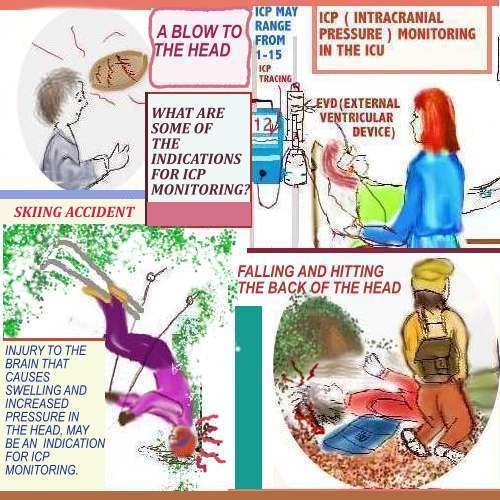
Learn more about: ICP for the layperson

NURSES, DO YOU TAKE TIME TO RELAX


Updated 1/25

Dear nurses,

Try to take time off to relax and enjoy a day out, whenever you can.
Avoid stress as much as possible!

Wednesday, August 05, 2009

EKG INTERPRETATION MADE EASY

Enjoy the video: EKG interpretation

Updated 2/26    Dearnurses.com is no longer available.


        Atrial fibrillation is a rapid , irregular arrhythmia.
 It is caused by the atria (upper heart chambers)
beating rapidly and out of character. There is no P
 wave on the EKG. This topic continues : Here

Scenario: The patient above, had surgery three days ago.
He is on anticoagulation therapy (Heparin) for DVT. 
Anticoagulants are blood thinners. Their purpose is to
 prevent blood from clotting too easily. 

 Patients with atrial fibrillation may be placed on
 anticoagulation therapy.

This topic continues : Here


Learn more about: Chest pain and the EKG