Dear Nurses

Wednesday, August 20, 2008

PCA ADMINISTRATION

 Updated 12/25

PCA ( Patient Controlled Analgesia)

Patient Controlled Analgesia may be ordered by
the doctor for the patient who is awake, alert and
able to self medicate. This method of administering
pain medication , is done via a pump, through the
intravenous route. Dosages are decided by the doctor.

However, patient and family teaching should be
included in the care plan. It is not uncommon for
family members to press the pain button for the
patient. Sessions 12 gives an overview of pain
assessment.

Indications for the use of the PCA pump include:
- patients who have surgical intervention
- patients with cancer or chronic pain issues
- conditions such as pancreatitis, sickle cell 
  anemia and more.


The Numerical Pain Scale is a useful tool when
assessing pain. It is based on a scale of 0-10.
A ladder starts from the ground and escalates to|
the highest point, so does pain start from 0-10.

It is important to do a pain assessment after pain
medication has been given. See image for more
information.


Friday, August 15, 2008

BRAIN ASSESSMENT

Updated 6/26
Dear nurses.
Stroke assessment is no longer available.
New information and links have been added below.

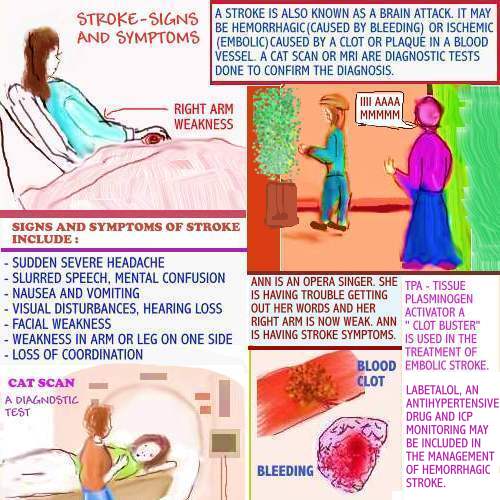
Scenario: In the image above, Ann is an opera
singer. While on stage, she suddenly starts having
trouble getting her words out. Her right arm also
feels weak. These symptoms are classic of someone
experiencing a stroke.

Signs and stroke symptoms:
- sudden , severe headache
- slurred speech, mental confusion
- nausea and vomiting
- visual disturbances, hearing loss
- facial weakness
- weakness in arm or leg on one side
A CAT scan or MRI or both may be done to 
confirm diagnosis.


Here are some brain teasers:

Q -What is the normal distance for testing visual acuity?
A- 14-20 feet away.

Q - What does stereognosis mean?
A- The ability to identify objects by touching.

Q - What part of the brain is responsible for blance
and coordination?
A- The cerebellum, which lies below the cerebrum.

Q- What does word salad mean?
A- A collection of words that have no real meaning.

Q- What is anisocoria?
A- Unequal pupils which occur in about 20% of the 
population.


Saturday, August 02, 2008

DEAR NURSES HAVE A GOOD WEEK AND LEARN MORE !

Updated 4/26

Dear nurses,

Dearnurses.com is no longer available.
New topics have been added below.


Patient assessment is a very important tool. 
The patient having chest pain, would have 
an assessment done by the nurse.

A description of the pain, as well as pain
scales assessment ( 1-10) is usually done.
Documentation of intervention is also 
necessary. 
Below are more assessment links:
 Neurological assessment
Abdominal assessment 


CAN TRAUMA HAPPEN INSIDE A TRAUMA


Updated 5/24
Dear nurses,
Dear nurses.com is no longer available. New links have
been added, to make learning easy.

When a trauma patient arrives in the Emergency Room,
it takes "all hands on deck" to help with this situation.
It is not uncommon for medical staff members to be
called from other areas of the hospital to assist.

It is important to take great care while rushing to the
trauma, otherwise another trauma may happen.


Learn more: Spinal injury 

UNDERSTANDING RESPIRATORY CARE FOR NURSES


Scenario: The patient in the image above, is on
mechanical ventilation.The ventilator alarms keep
going off. It is obvious that something is wrong.

The nurse did not take time to troubleshoot
 the problem and walks away. Please watch
 the videos by clicking on the links below:
Learn more about Exercise