Dear Nurses

Friday, January 29, 2010

NURSE - ARE THESE GOOD CLINICAL SKILLS?

Updated 8/25

Dear nurses.net is no longer available.
New images and topics have been added below.

The nurse above is about to make a medication error.
This is very poor judgement on her part.
Here are some helpful pointers for good medication administration:
- Follow MD orders
- Remember the five or more rights
- DO NOT USE COLOR CODING AS YOUR ONLY GUIDELINE.
Remember, many pills may have the same color, but that does not
mean they are of equal strength.
- If you are a new nurse and you are uncertain, consult with a more
 experienced nurse to help you out.
- Always follow your Institution's policies and procedures


The image above, is a reflection of what a clinical
nurse, should not do. Pay attention:
- you gave the wrong medication 
- you put a used syringe and needle, in an already
 full needle holder
- you left the IV pump running after discontinuing 
 the medication.

HELPFUL INFORMATION WHEN ADMINISTERING MEDICATIONS

Updated 8/25
Dear nurses,
The image above, offers helpful information for
the clinical nurse.

What is the MAR?

The MAR is the medication administration record.
It is a complete record which is kept on every patient.

It includes the patient's name, age, diagnosis, height,
weight and allergies. All medications ordered by the
doctor and a place to sign when medications are given.

Five rights:

There are 5 basic rights for medication administration.
Over time, more rights have been recognized. This may 
vary from 7 or more. Always follow your Institution's
policies and procedures, in order to avoid error.


Scenario 1: Lynn is a new RN. Her preceptor did
not do a good job explaining the correct way to do 
an assessment. Lynn is not aware of the mistake
she is about to make.
Learn more about : Was an assessment done?

Friday, January 08, 2010

PHARMACOLOGY FOR NURSES

Updated 12/24
Dear nurses,
Dearnurses.net is no longer available.

Sessions 28-Pharamcology for Nurses is intended to help
nursing students and nurses in the clinical setting.

Topics include:
- Hospital Admission/Pharmacy
- Allergic Reaction to Medication
- Routes of Administration 
- Narcotics Uses and side effects in the Clinical Setting)
DOs and DON'Ts in the Clinical Setting


WHERE IS THE MEDICATION LABEL?

In an emergency situation, do you remember
to label the IV solutions with the correct additives?
Learn more about what to do and not to do in the
clinical setting.
Just click on the link:
Pharmacology for nurses ( Chapter 4)
and enjoy learning.

DISPOSAL OF USED NEEDLES AND SYRINGES

Updated 3/26

Enjoy watching the video: Safe medication administration


The standards of care are an essential part of  the
Nursing profession. It provides guidelines within a
framework of practices.
Learn more about : The standards of care

Learn more about : Nursing communication


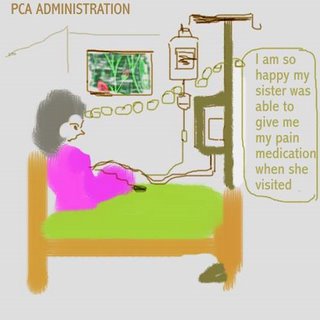
PCA ( Patient Controlled Analgesia)

Patient Controlled Analgesia may be ordered by
the doctor for the patient who is awake, alert and
able to self medicate. This method of administering
pain medication , is done via a pump, through the
intravenous route. Dosages are decided by the doctor.

However, patient and family teaching should be
included in the care plan. It is not uncommon for
family members to press the pain button for the
patient. Sessions 12 gives an overview of pain
assessment.

Indications for the use of the PCA pump include:
- patients who have surgical intervention
- patients with cancer or chronic pain issues
- conditions such as pancreatitis, sickle cell 
  anemia and more.


The Numerical Pain Scale is a useful tool when
assessing pain. It is based on a scale of 0-10.
A ladder starts from the ground and escalates to|
the highest point, so does pain start from 0-10.

It is important to do a pain assessment after pain
medication has been given. See image for more
information.