Dear Nurses

Friday, July 31, 2009

DEFIBRILLATION AND ITS CONSEQUENCES


Updated 8/26

Scenario: A Code Blue is in progress in the Emergency Room.
The medical staff have gathered around the bedside to assist.
Unfortunately, the nurse on the left got distracted . She begins
to move the paddles towards the nurse on the right.

How could this happen? It is easy to make a mistake when there
is so much goingon in a confined space. It is important to follow
all the security guidelines for a Code Blue, like making sure no
one is close to the bedside prior to defibrillation.

Hemodynamics and its meaning

Hemodynamics refers to blood flow.
 The heart is a pump, which pumps blood around the body.
 If there is damage, like a myocardial infarction, the heart's
 function will be impaired.

Signs and symptoms include: chest pain,
shortness of breath and EKG changes.


A cardiopulmonary arrest can happen anywhere.
In an ICU setting, trained staff members (ACLS)
are usually on hand when a Code Blue is called.

Learn more about this topic by clicking on the link:
Hemodynamic Monitoring
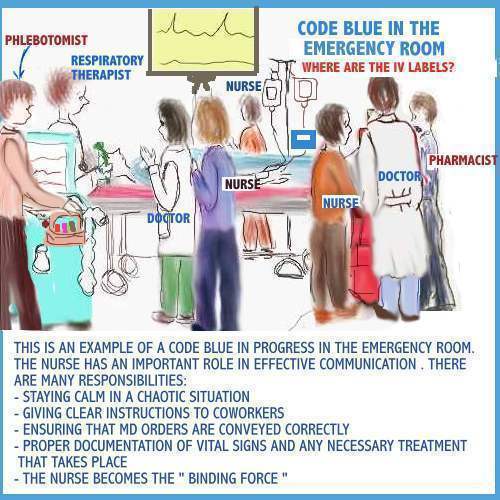


The image above shows a Code blue in progress. This is 
happening in the Emergency Room. Always follow your
Institution's policies and procedures for Code Blue. 

What is the role of the nurse who is assigned to the Code Blue?

The nurse has an important role in effective communication.
There are many responsibilities.
- staying calm in a chaotic situation
- giving clear instructions to coworkers
- ensuring that MD orders are conveyed correctly
- proper documentation of vital signs and all treatments /
  interventions that take place ( defibrillation for example)
  - the nurse becomes the " binding force

Addressing lethal rhythms

There are some EKG rhythms that are considered to be lethal.
Immediate intervention is necessary for good outcomes. Here are
the most lethal rhythms:

Asystole - sometimes referred to as " flat-line. The electrical
heart's conduction system is not functioning. There are no
ventricular contractions. The patient is pulseless and
unresponsive.

Ventricular Tachycardia - There may or may not be a pulse
present. The ventricles are beating rapidly and there is no atrial
activity. Blood flow to the vital organs is compromised.

Ventricular Fibrillation -  There is a chaotic rhythm and no
atrial activity. The ventricles are quivering , so there is no 
cardiac output. There is no pulse and the patient may become
unresponsive. Immediate action to defibrillate is usually done.


***American Heart Association has protocols in place for each
EKG rhythm.


Learn about : the ABG and Code Blue
Learn more about : The Circulatory System


Tuesday, June 13, 2006

UNDERSTANDING WHEN CPR IS NECESSARY


Updated 8/25

Dear nurses, 

The Clinical Setting Step by Step is no longer available.


The image above shows a Code blue in progress. This is 
happening in the emergency Room. Always follow your
Institution's policies and procedures for Code Blue. 

The role of the nurse who is assigned to the Code Blue

The nurse has an important role in effective communication.
There are many responsibilities.
- staying calm in a chaotic situation
- giving clear instructions to coworkers
- ensuring that MD orders are conveyed correctly
- proper documentation of vital signs and all treatments /
  interventions that take place ( defibrillation for example)
  - the nurse becomes the " binding force.


It is important to recognize that as nurses, we may be floated 
to an unfamiliar environment. Having a good knowledge base
of such topics like CPR and knowing how to read an EKG is of
great importance. 

 Organizational skills in the clinical setting do matter.

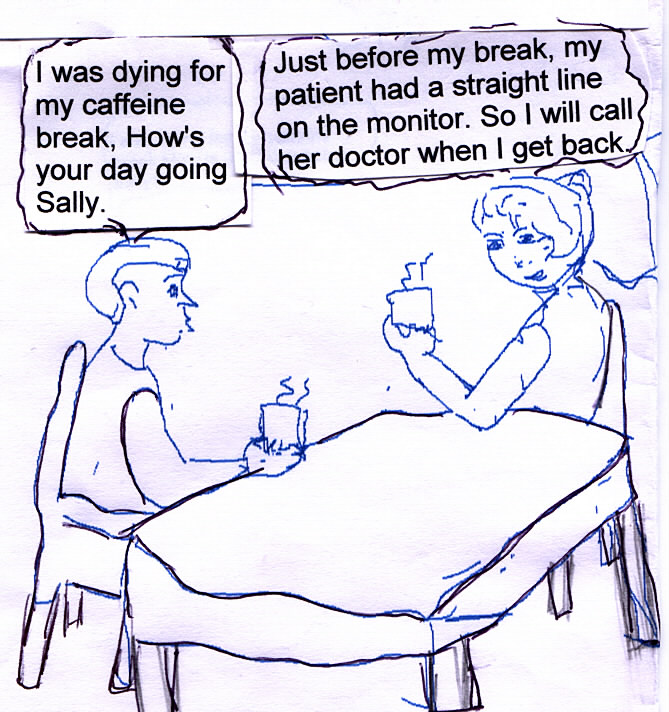
A patient who has a straight line on the monitor,
requires immediate intervention. The nurse should
check the patient to make sure an electrode is not 
disconnected. 

If there is no disconnection, the patient may have 
gone into Cardiopulmonary arrest. This calls for 
CPR.

A Cardiopulmonary arrest is called a Code Blue.
This means the heart has 
stopped beating and the
body's cells are deprived of blood supply and 
oxygen.

Immediate action is taken by the staff , to call a Code
Blue overhead. This 
summons trained personnel to
that patient's bedside. 


Scenario: In the above scenario, Mr. R is anxious
and feeling short of breath. 

The patient in Congestive heart failure, will display
signs of anxiety, due to lack of oxygen.The damaged
heart cannot pump blood as efficiently as a healthy 
heart. 

Chest pain and shortness of breath will likely be present. 
As a result of heart damage, fluid backs up into the lungs.

The patient who has an anterior wall myocardial infarction
may develop CHF. A higher level of care is usually needed. 

Watch the videos: Hemoynamic monitoring

The image above, gives an indication of what 
happens to the patient in Congestive heart failure.

Causes include : Hypertensionmyocardial infarction,
cardiomyopathy are some examples. See above image.


Sunday, January 04, 2009

WHEN CPR IS NEEDED IN THE EMERGENCY ROOM

   Updated 8/25

Dearnurses.net is no longer available.

New information has been added below.


The image above shows a Code blue in progress. This is 
happening in the emergency Room. Always follow your
Institution's policies and procedures for Code Blue. 

The role of the nurse who is assigned to the Code Blue

The nurse has an important role in effective communication.
There are many responsibilities.
- staying calm in a chaotic situation
- giving clear instructions to coworkers
- ensuring that MD orders are conveyed correctly
- proper documentation of vital signs and all treatments /
  interventions that take place ( defibrillation for example)
  - the nurse becomes the " binding force.


Scenario: Mrs. R is a 48 year-old female who has a history
of a previous myocardial infarction. She was admitted 2 days
 ago with mild chest pain. She was resting comfortably when
she suddenly started feeling short of breath. She is anxious 
and calls the nurse.

What actions did the nurse take?
-The nurse reassures Mrs. R. She does an assessment, vital signs
, and oxygen saturation. She gives oxygen per protocol.

The nurse notifies the doctor of what has occurred and her
assessment findings. She also mentions the vital signs, low
oxygen saturation, and steps that were taken to correct the
saturation. The doctor gives further orders, including a
transfer to CCU.

Why chest pain assessment?
It must be remembered that a patient with heart damage
 will also experience chest pain. Assessment of the pain
should also be included. This may be sharp, with radiation
 to the shoulder/jaw, or it may feel like chest pressure.


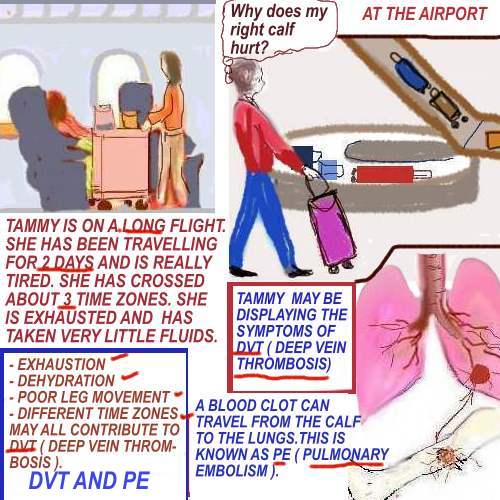
Learn more about : ARDS, DVT and PE

Monday, December 15, 2025

UNDERSTANDING SAFE NURSING PRACTICES - A NURSE'S PRIORITIES


When a nurse's priorities are wrong

In the image above, Jenna is a new nurse.
She has not fully understood the importance
of safe nursing practices.

Her desperation to be on time to meet a friend
for lunch, took priority over patient safety.

Jenna works in the ICU. The monitor alarm 
of the patient in her care, was going off. She
made no attempt to check if something was
wrong.

It is important to understand that a patient who
is cared for in the ICU, requires a higher level
of care.

It is unfortunate Jenna did not prioritize.

The image above shows a Code blue in progress. This is 
happening in the Emergency Room. Always follow your
Institution's policies and procedures for Code Blue. 

The role of the nurse who is assigned to the Code Blue

The nurse has an important role in effective communication.
There are many responsibilities.
- staying calm in a chaotic situation
- giving clear instructions to coworkers
- ensuring that MD orders are conveyed correctly
- proper documentation of vital signs and all treatments ,
  interventions that take place ( defibrillation for example)
  - the nurse becomes the " binding force.

Learn more about: The Nursing Process

Learn more about : Nursing communication

Common causes of medication errors


Like the artist perfects painting skills, so does the
nurse perfect clinical skills!

Tuesday, July 13, 2021

CODE BLUE IN THE EMERGENCY ROOM


 Dear nurses,

Hope you had a good July 4th.
Above is an example of a Code Blue in an
Emergency Room. The nurse has an important
role in effective communication.

The responsibilities of the nurse are numerous:
- staying calm in a chaotic situation
- giving clear instructions to coworkers
- making sure , MD orders are carried out correctly
- proper documentation

The nurse becomes the " binding force".


What is the role of the Triage nurse?
 

The Triage nurse has the responsibility of prioritizing
which patient is critical and needs immediate attention
when working in the ER. 
Learn more by clicking on the link:


When taking care of a patient who has experienced a
traumatic event, the nurse should consider how to
explain to the patient and family what is being done.
If possible, get help from other staff members.

Learn more about : Communication skills

Saturday, September 14, 2024

A CODE BLUE IN PROGRESS AND THIS HAPPENS


Scenario: A Code Blue is in progress in the Emergency Room.
The medical staff have gathered around the bedside to assist.
Unfortunately, the nurse on the left got distracted . She begins
to move the paddles towards the nurse on the right.

How could this happen? It is easy to make a mistake when there
is so much goingon in a confined space. It is important to follow
all the security guidelines for a Code Blue, like making sure no
one is close to the bedside prior to defibrillation.

Addressing lethal rhythms

There are some EKG rhythms that are considered to be lethal.
Immediate intervention is necessary for good outcomes. Here are
the most lethal rhythms:

Asystole - sometimes referred to as " flat-line. The electrical
heart's conduction system is not functioning. There are no
ventricular contractions. The patient is pulseless and
unresponsive.

Ventricular Tachycardia - There may or may not be a pulse
present. The ventricles are beating rapidly and there is no atrial
activity. Blood flow to the vital organs is compromised.

Ventricular Fibrillation -  There is a chaotic rhythm and no
atrial activity. The ventricles are quivering , so there is no 
cardiac output. There is no pulse and the patient may become
unresponsive. Immediate action to defibrillate is usually done.


***American Heart Association has protocols in place for each
EKG rhythm


Learn about : the ABG and Code Blue
Learn more about : The Circulatory System

  Heart and lungs work together.


Saturday, March 08, 2008

ADDRESSING ASYSTOLE AND OTHER LETHAL HEART RHYTHMS

Updated 7/25


The image above shows a Code blue in progress. This is 
happening in the emergency Room. Always follow your
Institution's policies and procedures for Code Blue. 

What is the role of the nurse who is assigned to the Code Blue?

The nurse has an important role in effective communication.
There are many responsibilities.
- staying calm in a chaotic situation
- giving clear instructions to coworkers
- ensuring that MD orders are conveyed correctly
- proper documentation of vital signs and all treatments /
  interventions that take place ( defibrillation for example)
  - the nurse becomes the " binding force.


Addressing lethal EKG rhythms

There are some EKG rhythms that are considered to be lethal.
Instant intervention is necessary for good outcomes. Here are
the most lethal rhythms:

Asystole - sometimes referred to as " flat-line. The electrical
heart's conduction system is not functioning. There are no
ventricular contractions. The patient is pulseless and
unresponsive. immediate action has to be taken. 

Ventricular Tachycardia - There may or may not be a pulse
present. The ventricles are beating rapidly and there is no atrial
activity. Blood flow to the vital organs is compromised.

Ventricular Fibrillation -  There is a chaotic rhythm and no
atrial activity. The ventricles are quivering , so there is no 
cardiac output. There is no pulse and the patient may become
unresponsive. Immediate action to defibrillate is usually done.

***American Heart Association has protocols in place for each 
EKG rhythm.

The postoperative patient is at risk for hypothermia.
Fluid loss and exposure in the surgical suite, may predispose
 to hypothermia. A lethal cardiac arrhythmia may result.

 Hypothermia increases the body's demand for oxygen
 and if left untreated can lead to a myocardial infarction
 (heart attack). Trauma resulting in excessive blood loss, 
 as well as alcohol ingestion, may also lead to hypothermia.

Saturday, March 01, 2008

RECOGNIZING TORSADES DE POINTES


Torsades de Pointes is a form of Ventricular Tachycardia. 
It is rare and requires IMMEDIATE TREATMENT!
***American Heart Association has protocols in place for
each EKG rhythm.

Causes include: hypomagnesium, antiarrhythmic drugs 
that may prolong the Q-T interval and myocardial infarction.
Quinidine may cause Torsades de Pointes.
Symptoms include - Dizziness, chest pain
shortness of breath, hypotension and palpitations.


The image above shows a Code blue in progress. This is 
happening in the Emergency Room. Always follow your
Institution's policies and procedures for Code Blue.
 Learn more about: Lethal rhythms and Code Blue


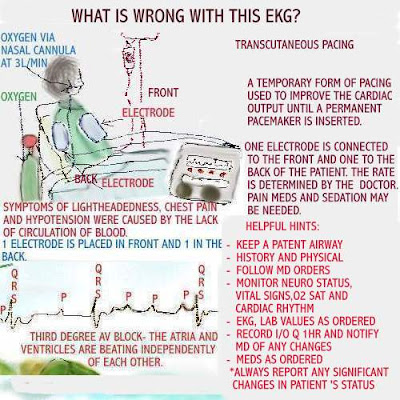
The patient above was brought in to the 
Emergency Room with complaints of chest
pain and a drop in blood pressure.
Learn more about : Code Blue and avoiding errors


Learn more about : Third degree AV block

Sunday, October 19, 2008

EKG RHYTHMS - STEP BY STEP


 Updated 7 /26              
 Dearnurses.net is no longer available.

Dear nurses,
New information and links have been added.
below.


The image above shows a Code blue in progress.
This is happening in the Emergency Room. Always
follow your Institution's policies and procedures for
Code Blue. Learn more about: Lethal rhythms

The heart is always at work. Hemodynamics refers
to blood flow. Any obstruction to the flow of blood
in and around the heart, may lead to failure.


Poor circulation may occur for a number of reasons.
The patient in heart failure, is at risk for stroke.

Myocardial infarction

A MI (myocardial infarction ) is also known as a heart
attack. It results from obstruction to blood flow. Fatty
deposits may cause this. 

Death of the heart muscle surrounding the obstructed
blood vessel will result. Symptoms such as lack of oxygen,
shortness of breath and chest pain will occur.

 Reperfusion Therapy is a form of treatment used

for patients who have a myocardial infarction with 
STEMI ( ST segment elevation myocardial infarction).
See above image for an example of STEMI.

STEMI 

Typically, the patient with a completely blocked
coronary artery, would demonstrate STEMI on 
the EKG. Death of the heart muscle caused by a
blood clot, would obstruct blood flow and cause
lack of oxygen.  

Severe chest pain, shortness of breath and possible
fainting may occur. Quick intervention would be
necessary to prevent further damage

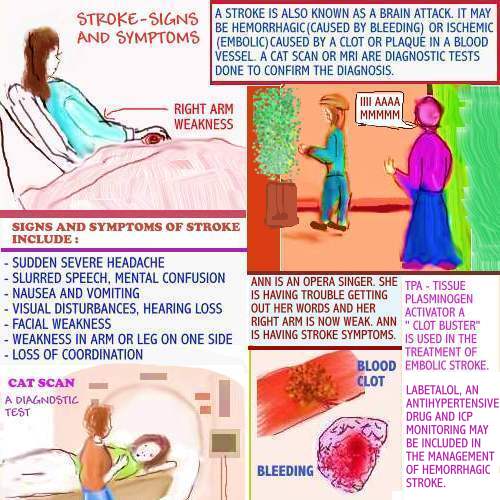
TPA

TPA ( Thrombolytic Plasminogen Activator) is
a " clot buster" that is used in the treatment of 
embolic stroke and myocardial infarction with
STEMI. 

TPA  is not without its side effects. Bleeding
particularly into the brain and at injection sites,
 seizures and possible anaphylaxis may occur.

Labetolol , an antihypertensive may be ordered.
ICP monitoring may also be ordered by the doctor.


Learn about : the ABG and Code Blue


Sunday, May 31, 2009

CHEST PAIN - ASSESSMENT, DOCUMENTATION AND INTERVENTION

Updated 10/25

Dear nurses,

New information and links on Chest pain assessment
has been added below.

Chest pain should always be assessed!


Learn more about: Chest pain assessment


The image above shows a Code blue in progress. This is 
happening in the emergency Room. Always follow your
Institution's policies and procedures for Code Blue. 

What is the role of the nurse who is assigned to the Code Blue?

The nurse has an important role in effective communication.
There are many responsibilities.
- staying calm in a chaotic situation
- giving clear instructions to coworkers
- ensuring that MD orders are conveyed correctly
- proper documentation of vital signs and all treatments /
  interventions that take place ( defibrillation for example)
  - the nurse becomes the " binding force


Scenario: Mrs. R is a 48 year-old female who has a history
of a previous myocardial infarction. She was admitted 2 days
 ago with mild chest pain. She was resting comfortably when
she suddenly started feeling short of breath. She is anxious 
and calls the nurse.

What actions did the nurse take?
-The nurse reassures Mrs. R. She does an assessment, vital signs
, and oxygen saturation. She gives oxygen per protocol.

The nurse notifies the doctor of what has occurred and her
assessment findings. She also mentions the vital signs, low
oxygen saturation, and steps that were taken to correct the
saturation. The doctor gives further orders, including a
transfer to CCU.

Why chest pain assessment?
It must be remembered that a patient with heart damage
 will also experience chest pain. Assessment of the pain
should also be included. This may be sharp, with radiation
 to the shoulder /jaw, or it may feel like chest pressure.


Saturday, January 26, 2008

WHAT IS WRONG WITH THIS EKG SERIES

Learn more about : Atrial fibrillation - An overview

Updated 10/25

Dear nurses,

The EKG series is no longer available.
New information has been added below.

The heart is always at work. Even when you 
 are asleep, the heart continues to work. 
Hemodynamics refers to blood flow.

Any obstruction to the flow of  blood around
the heart, may lead to heart failureLearn more
about the heart and the EKG by watching
the video: Sessions 68- Quiz 1


Learn more about : Post stroke- Why Therapy


The image above shows a Code blue in progress. This is 
happening in the Emergency Room. Always follow your
Institution's policies and procedures for Code Blue. 

What is the role of the nurse who is assigned to the Code Blue?

The nurse has an important role in effective communication.
There are many responsibilities.
- staying calm in a chaotic situation
- giving clear instructions to coworkers
- ensuring that MD orders are conveyed correctly
- proper documentation of vital signs and all treatments /
  interventions that take place ( defibrillation for example)
  - the nurse becomes the " binding force


Saturday, March 08, 2008

WHAT IS WRONG WITH EKG-TREATMENT OF VENTRICULAR FIBRILLATION

Updated 1/25
Dear nurses,
Dearnurses.com is no longer available.
  
Ventricular Fibrillation is a lethal rhythm.
Its hallmark is no pulse, no heart contractions
and a chaotic EKG rhythm,which is demonstrated
above.

There is also no atrial activity. The ventricles are
quivering , so there is no cardiac output. The patient
may become unresponsive. Immediate action to
defibrillate is usually done.

***American Heart Association has protocols in
place for each EKG rhythm.

Causes and Treatment of Ventricular Fibrillation
are outlined above.

For more information, please click on the links below:


The image above shows a Code blue in progress. This is 
happening in the emergency Room. Always follow your
Institution's policies and procedures for Code Blue. 

What is the role of the nurse who is assigned to the Code Blue?

The nurse has an important role in effective communication.
There are many responsibilities.
- staying calm in a chaotic situation
- giving clear instructions to coworkers
- ensuring that MD orders are conveyed correctly
- proper documentation of vital signs and all treatments /
  interventions that take place ( defibrillation for example)
  - the nurse becomes the " binding force.


Saturday, June 14, 2008

UNDERSTANDING CODE BLUE


Updated 8/25


The image above shows a Code blue in progress. This is 
happening in the emergency Room. Always follow your
Institution's policies and procedures for Code Blue. 

What is the role of the nurse who is assigned to the Code Blue?

The nurse has an important role in effective communication.
There are many responsibilities.
- staying calm in a chaotic situation
- giving clear instructions to coworkers
- ensuring that MD orders are conveyed correctly
- proper documentation of vital signs and all treatments /
  interventions that take place ( defibrillation for example)
  - the nurse becomes the " binding force.


Learn more about: Mechanical ventilation

Learn more about: Triage