Dear Nurses

Saturday, July 19, 2008

THE EMERGENCY ROOM


Above are clinical scenarios that each tell their own story.
Just click on the link above for more helpful information.

Updated 1/25

                                                           Eye injury

An eye injury may occur at anytime and anywhere,
sometimes in the workplace. It is important to recognize
that quick intervention is of paramount importance.

Helpful hints:
Always lift try to lift large objects away from the eyes.
If something splashes in the eye, washing it out of the eye and
seeking medical treatment may be necessary.

Hyphema - Blood in the anterior chamber of the eye caused by
blunt trauma.(See image).


                                                                    Spinal injury


Scenario: Jim had a few extra drinks to celebrate his birthday.
He dives into the shallow end of the pool. Unfortunately, he will
have to be taken to the Emergency Room for further treatment.

                                Emergency Room vs. Urgent Care

Recently there have been changes in the way emergencies
are handled. Some situations are minor and do not need
        a high level of care. Triage is very important in distinguishing
how to filter patients to the right facility.

Minor cuts, bruises, infection and less severe pain may be treated in 
an Urgent Care. More severe conditions like burns, head and spinal 
trauma, stroke symptoms and a cardiac event may require a higher
level of care like an Emergency Room.


Tuesday, June 11, 2013

ADDRESSING THE EMERGENCY ROOM


The Emergency Room is an important part
of any hospital, for a number of reasons.
Any patient with an emergent situation will
need intervention in this area.

The nurse has an important role to play with
assessment and following MD orders for
treatment and transfer to the appropriate unit
in the hospital, or to discharge the patient.

Above, the nurse is doing an assessment on
a patient in hypovolemic shock, following
trauma. Signs and symptoms include:
- rapid respirations 
- rapid heart rate
- cool, clammy skin

It takes "all hands on deck" to complete the work.

It is important to recognize that classroom skills
are different from clinical skills. A nurse's
performance in the work place takes on a different 
challenge from the classroom.

Learn more about: Hemodynamic Monitoring and


Learn more about: 

Common causes of medication errors

 IV infiltration may cause damage to the skin and
surrounding tissue.Learn more about: IV 

Tuesday, July 13, 2021

CODE BLUE IN THE EMERGENCY ROOM


 Dear nurses,

Hope you had a good July 4th.
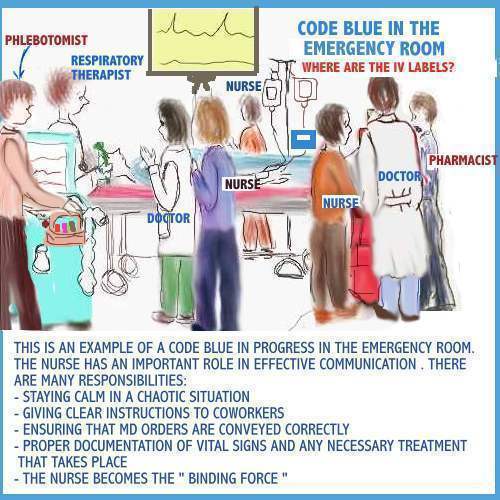
Above is an example of a Code Blue in an
Emergency Room. The nurse has an important
role in effective communication.

The responsibilities of the nurse are numerous:
- staying calm in a chaotic situation
- giving clear instructions to coworkers
- making sure , MD orders are carried out correctly
- proper documentation

The nurse becomes the " binding force".


What is the role of the Triage nurse?
 

The Triage nurse has the responsibility of prioritizing
which patient is critical and needs immediate attention
when working in the ER. 
Learn more by clicking on the link:


When taking care of a patient who has experienced a
traumatic event, the nurse should consider how to
explain to the patient and family what is being done.
If possible, get help from other staff members.

Learn more about : Communication skills

Friday, July 31, 2009

DEFIBRILLATION AND ITS CONSEQUENCES


Updated 8/26

Scenario: A Code Blue is in progress in the Emergency Room.
The medical staff have gathered around the bedside to assist.
Unfortunately, the nurse on the left got distracted . She begins
to move the paddles towards the nurse on the right.

How could this happen? It is easy to make a mistake when there
is so much goingon in a confined space. It is important to follow
all the security guidelines for a Code Blue, like making sure no
one is close to the bedside prior to defibrillation.

Hemodynamics and its meaning

Hemodynamics refers to blood flow.
 The heart is a pump, which pumps blood around the body.
 If there is damage, like a myocardial infarction, the heart's
 function will be impaired.

Signs and symptoms include: chest pain,
shortness of breath and EKG changes.


A cardiopulmonary arrest can happen anywhere.
In an ICU setting, trained staff members (ACLS)
are usually on hand when a Code Blue is called.

Learn more about this topic by clicking on the link:
Hemodynamic Monitoring


The image above shows a Code blue in progress. This is 
happening in the Emergency Room. Always follow your
Institution's policies and procedures for Code Blue. 

What is the role of the nurse who is assigned to the Code Blue?

The nurse has an important role in effective communication.
There are many responsibilities.
- staying calm in a chaotic situation
- giving clear instructions to coworkers
- ensuring that MD orders are conveyed correctly
- proper documentation of vital signs and all treatments /
  interventions that take place ( defibrillation for example)
  - the nurse becomes the " binding force

Addressing lethal rhythms

There are some EKG rhythms that are considered to be lethal.
Immediate intervention is necessary for good outcomes. Here are
the most lethal rhythms:

Asystole - sometimes referred to as " flat-line. The electrical
heart's conduction system is not functioning. There are no
ventricular contractions. The patient is pulseless and
unresponsive.

Ventricular Tachycardia - There may or may not be a pulse
present. The ventricles are beating rapidly and there is no atrial
activity. Blood flow to the vital organs is compromised.

Ventricular Fibrillation -  There is a chaotic rhythm and no
atrial activity. The ventricles are quivering , so there is no 
cardiac output. There is no pulse and the patient may become
unresponsive. Immediate action to defibrillate is usually done.


***American Heart Association has protocols in place for each
EKG rhythm.


Learn about : the ABG and Code Blue
Learn more about : The Circulatory System


Sunday, January 04, 2009

WHEN CPR IS NEEDED IN THE EMERGENCY ROOM

   Updated 8/25

Dearnurses.net is no longer available.

New information has been added below.


The image above shows a Code blue in progress. This is 
happening in the emergency Room. Always follow your
Institution's policies and procedures for Code Blue. 

The role of the nurse who is assigned to the Code Blue

The nurse has an important role in effective communication.
There are many responsibilities.
- staying calm in a chaotic situation
- giving clear instructions to coworkers
- ensuring that MD orders are conveyed correctly
- proper documentation of vital signs and all treatments /
  interventions that take place ( defibrillation for example)
  - the nurse becomes the " binding force.


Scenario: Mrs. R is a 48 year-old female who has a history
of a previous myocardial infarction. She was admitted 2 days
 ago with mild chest pain. She was resting comfortably when
she suddenly started feeling short of breath. She is anxious 
and calls the nurse.

What actions did the nurse take?
-The nurse reassures Mrs. R. She does an assessment, vital signs
, and oxygen saturation. She gives oxygen per protocol.

The nurse notifies the doctor of what has occurred and her
assessment findings. She also mentions the vital signs, low
oxygen saturation, and steps that were taken to correct the
saturation. The doctor gives further orders, including a
transfer to CCU.

Why chest pain assessment?
It must be remembered that a patient with heart damage
 will also experience chest pain. Assessment of the pain
should also be included. This may be sharp, with radiation
 to the shoulder/jaw, or it may feel like chest pressure.


Learn more about : ARDS, DVT and PE

Saturday, March 01, 2008

RECOGNIZING TORSADES DE POINTES


Torsades de Pointes is a form of Ventricular Tachycardia. 
It is rare and requires IMMEDIATE TREATMENT!
***American Heart Association has protocols in place for
each EKG rhythm.

Causes include: hypomagnesium, antiarrhythmic drugs 
that may prolong the Q-T interval and myocardial infarction.
Quinidine may cause Torsades de Pointes.
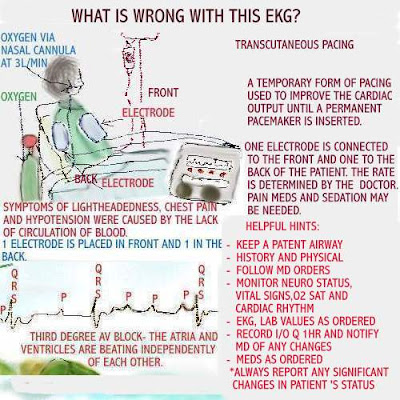
Symptoms include - Dizziness, chest pain, 
shortness of breath, hypotension and palpitations.


The image above shows a Code blue in progress. This is 
happening in the Emergency Room. Always follow your
Institution's policies and procedures for Code Blue.
 Learn more about: Lethal rhythms and Code Blue


The patient above was brought in to the 
Emergency Room with complaints of chest
pain and a drop in blood pressure.
Learn more about : Code Blue and avoiding errors


Learn more about : Third degree AV block

Sunday, June 05, 2011

WHAT'S HAPPENING IN THE ER ?

Updated 5/25
Dear nurses,

Dearnurses.net is no longer available. New information 
has been added below.
In the above Emergency Room scenario, a patient has been
transported to the ER. Medical staff members are gathered
around the bedside.

Learn more by clicking on the link below:


Scenario: In the above image, a patient was brought into 
the Emergency room with complaints of chest pain and
a drop in 
blood pressure. 

This topic continues below.
Please click on the link : Avoiding medication errors


An intravenous infusion may be started in a peripheral
site or a central line site.

Learn more by clicking on the link:
IV assessment


Saturday, December 01, 2007

TRAUMA SERIES "THE GOLDEN HOUR"

Updated 2/26

Dear nurses,  
Dearnurses.net is no longer available.

New information and links have been 
added below. Enjoy learning!


It takes "all hands on deck" to complete the work.

It is important to recognize that classroom skills
are different from clinical skills. A nurse's
performance in the work place takes on a different 
challenge from the classroom.

Learn more about: Hemodynamic Monitoring and


Scenario: In the above image, a patient was brought into the 
Emergency room, with complaints of chest pain and a drop in 
blood pressure. The doctor ordered Morphine for the pain and
Dopamine for the hypotension. Both medications were given 
as ordered. The nurse in the green top (left) gave the Morphine
and started the Dopamine infusion.

Medication administration
Next : What went wrong? The nurse forgot to put a label on
 the 
IV bag and did not document what time both medications
were 
given. 

It is very important for the nurse to pay close attention to
the time that medications are given. Documentation is also
important.
Learn more about : Types of medication errors


An intravenous infusion may be started in a peripheral
site or a central line site.

Learn more by clicking on the link:
IV assessment


Friday, July 11, 2008

A PREVIEW OF EMERGENCY ROOM CARE


Not every nurse has ever experienced working in an Emergency Room. Next week , Chapter7 of THE CLINICAL SETTING STEP BY STEP, will focus on what a shift in the ER would be like.
Topics include:
Role of the Triage Nurse
Patient with Chest Pain/Shortness of Breath
Febrile Child (Febrile Seizures)
Wrist Fracture
Also enjoy watching the Clinical videos.

Saturday, October 27, 2007

EMERGENCY FOR NURSES


Updated 7/24
Dear nurses,

This has been a very sad week for many who had to be
 evacuated and lost their homes, due to fires in Southern
California, USA. My prayers go out to all who were involved
in one way or another.

Have you ever been in an emergency situation?
Have you ever been unable to get home and take
 care of your daily responsibilities? 

Whether the answer is yes or no, here are some helpful pointers:-
- try to keep an extra change of clothes and toiletries in your car,
  for emergency use.
- have a contact number to reach someone who can pick up your 
   kids etc. if you are unable to do so.
- keep some non-perishable foods in your car , so you can have 
  something to eat in an emergency.
- if there is a co-worker who has had a tragic lost, try to share 
  your love and maybe pick up a collection to help out. 
  Have a great week!
  For more clinical information, click on the link:
 Emergency Room 


It takes "all hands on deck" to complete the work.

It is important to recognize that classroom skills
are different from clinical skills. A nurse's
performance in the work place takes on a different 
challenge from the classroom.

Learn more about: Hemodynamic Monitoring and


An intravenous infusion may be started in a peripheral
site or a central line site.

Learn more by clicking on the link:
IV assessment

Trauma can sometimes be prevented!


Thursday, November 26, 2009

ADDRESSING CODE BLUE AND MEDICATION ERRORS

Updated 8/25
Dear nurses,


Scenario: In the above image, a patient was brought into the 
Emergency room with complaints of chest pain and a drop in 
 blood pressure. The doctor ordered Morphine for the pain and 
Dopamine for the hypotension. Both medications were given
  as ordered. The nurse in the green top (left) gave the Morphine
and started the Dopamine infusion.

Next : What went wrong? The nurse forgot to put a label on the
 IV bag and did not document what time both medications were 
 given. It is very important for the nurse to pay close attention 
to the time that medications are given. 
Learn more about emergency events:
Types of medication errors


The image above shows a nurse trying to do a math calculation,
Please take a moment to read and understand what this is about.
Using Decimals  
Have a good day.


Saturday, September 08, 2007

SPINAL SHOCK


Updated  8/23

The patient above, has sustained a spinal injury.
To learn more about this topic,
please click on the link:

Friday, October 19, 2012

BONES , MUSCLES AND JOINTS


Updated 7 /26
Dear nurses,

Just click on the links below:
An Emergency Room experience
Bones , muscles and joints
and enjoy learning.


 Learn more by clicking on the links: Chest and Abdominal trauma


Learn more about : Pneumothorax


Scenario: Pam has been admitted to the hospital
with complaints of abdominal pain over a period
of time. The doctor has decided to do an ERCP
( Endoscopic Retrograde Cholangiopancreatography)
for this questionable abdominal pain.

This will be reflected in the care plan.


Learn more about: Sepsis

Sunday, May 19, 2013

UNDERSTANDING THE CBC ( COMPLETE BLOOD COUNT )

Updated 8/25


Scenario: Two passersby noticed a woman face 
down on the beach. They called 911 and the woman 
was transported to the Emergency Room.

She would later be identified. Lab values were done. 
Her history would reveal, surgical intervention 1 week
ago. Her WBCs were elevated. She also had a high fever.
There were questions raised about a Septic event. She 
was then transported to the ICU.

The CBC(complete blood count) ) is one of many
lab values that are helpful as a diagnostic tool.

 The RBCs( red blood cells, WBCs ( white blood count)
         and platelets are part of this test. Conditions such as anemia
and infection can be detected from this blood test.


A blood transfusion may be ordered for the patient with
 anemia. it is important for the nurse to be aware of the signs
of a blood transfusion reaction.

                   Learn more, by clicking on the link :
             Lab values and diagnostic tests 


Learn more about : Anticoagulation Therapy and
Enjoy the video: Anticoagulation therapy

Learn more about: The Circulatory System