Dear Nurses

Thursday, November 30, 2006

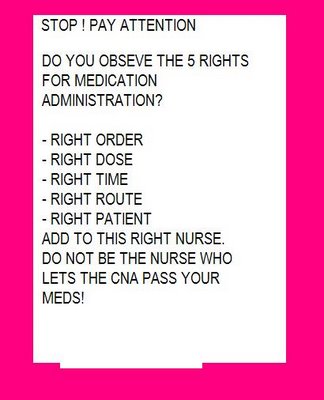
RED ALERT FOR MEDICATION ADMINISTRATION

Updated 4/25

Dear nurses,


Medication administration is a necessary part of a nurse's 
daily routine. However, it is important to make every attempt

Here are some helpful hints:
- CHECK MD ORDER
- FOLLOW YOUR INSTITUTION'S POLICIES AND PROCEDURES
FOR ADMINISTRATION OF NARCOTIC DRIPS
- AVOID RUSHING WHEN CHECKING MEDICATIONS.
- AVOID CHECKING ORDERS AND TALKING ON THE PHONE.
- IT IS OKAY TO BE OVERLY CAUTIOUS WHEN PASSING MEDICATIONS.

Medication doses are shown in the image above.

Tuesday, November 28, 2006

TIRED VEINS


Updated 5/25
Dear nurses,

Hope you had a good week. 

Many nurses work in an environment where
being on one's feet for long periods of time, 
is normal in a day's work.

In he image above, there are some helpful
suggestions for healthy feet. 

Enjoy learning more about the heart and
circulation below.


Scenario: The patient above, had surgery three days ago.
He is on anticoagulation therapy.

Learn more about : Anticoagulation therapy


Updated 4/24
For helpful clinical information, please click on the link :
Chest pain 


TIRED VEINS

Updated 5'25
Dear nurses,

Hope you had a good week. 

Many nurses work in an environment where
being on one's feet for long periods of time, 
is normal in a day's work.

In he image above, there are some helpful
suggestions for healthy feet. 

Enjoy learning more about the heart and
circulation below.


FRAZZLED NURSE

Updated 4/24
Dear nurses,

You do not have to be frazzled!.There is so much to learn
about this wonderful profession.
 Learn more : Quizmenurse


OVER-BURDENED NURSE

Updated 6/25

Dear nurses,
Dearnurses.net is no longer available.

 It is important to feel ready for the challenges
   that lay ahead. New information and links have
been added below. Enjoy Learning!


Learn more about - Chest pain assessment


The role of the Preceptor 
A Preceptor has a very important role to play in
training new nurses.
Learn more by clicking on the link:
Nurse's Critical Thinking


Learn more about : Postoperative care

Sunday, November 12, 2006

MEDICATION ADMINISTRATION

Dear nurses,
Updated 3/24
The Clinical Setting step by step is no longer available.
Please click on the links for more helpful information:


Learn more about - Medication administration


Here are some diagnostic tests that are done frequently.

Follow the links below:

1. Chest X ray
2. CAT scan
3. EKG
4. MRI scan
5. Ultrasound
6. Echocardiogram


INFECTION CONTROL


Infection may spread in many ways. Colds and flu's
result from a weakened Immune system. The handling
of food and poor hand washing techniques may encourage
the spread of infection.

Every nurse knows that infection control is essential in
the clinical setting. Every institution has policies and
procedures in place about the standards of care for
infection control.
 
Learn more about Septic Shock.

SCRUBS UNLIMITED

Updated 4/24
Dear nurses,

Dear nurses.net is no longer available. For more
updated information, please click on the link:


Learn more about:  Trauma and Sepsis


Scenario: Nick is a 21 year old male, who was on his way 
to work , when he became involved in a head on collision.
Someone called 911 and paramedics arrived on scene, to
resuscitate him.

SCRUBS UNLIMITED

 Updated 4/24
 Dear nurses,
Dearnurses.net is no longer available.For more
updated information, please click on the link:

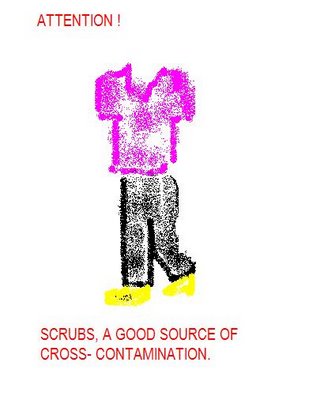
it is important to prevent the spread of infection.
Wearing scrubs in the workplace and not the shopping
malls and grocery stores are helpful.


An intravenous infusion may be started in a peripheral
site or a central line site.

Learn more by clicking on the link:
IV assessment


Learn more about : Sepsis


The surgical patient is at risk for infection, related to
  surgical intervention.
Paralytic ileus may occur .
- Hypothermia due to fluid loss and bodily exposure
  during surgery. Hypothermia increases the body's need
  for oxygen and possibly may lead to a cardiac event.
 Warming measures are necessary.


What is the role of the nurse educator?
The nurse educator is fully engaged in teaching 
the student nurses about the importance of taking
the necessary precautions to prevent the spread of
infection in the hospital setting. 
Learn more about: The Immune system


Saturday, November 04, 2006

CARDIAC ASSESSMENT

Myocardial infarction

A MI (myocardial infarction ) is also known as a heart
attack. It results from obstruction to blood flow. Fatty
deposits may cause this. 

Death of the heart muscle surrounding the obstructed
blood vessel will result. Symptoms such as lack of oxygen,
shortness of breath and chest pain will occur.


Reperfusion Therapy is a form of treatment used
for patients who have a myocardial infarction with 
STEMI ( ST segment elevation myocardial infarction).
See above image for an example of STEMI.

STEMI 

Typically, the patient with a completely blocked
coronary artery, would demonstrate STEMI on 
the EKG. Death of the heart muscle caused by a
blood clot, would obstruct blood flow and cause
lack of oxygen

Severe chest pain, shortness of breath and possible
fainting may occur. Quick intervention would be
necessary to prevent further damage