Dear Nurses

Wednesday, October 15, 2008

MYOCARDIAL INFARCTION - NURSING ASSESSMENT

Updated 12/25          Dearnurses.com is no longer available.

Dear nurses,
New topics and links have been added below.

The 12 lead EKG is done to analyze a myocardial
infarction's location. The electrical activity of the
heart is taken from 12 different angles, just like a
camera taking a picture from different views. 

Learn more about this topic by watching the video:

Scenario: Mrs. R is a 48 year-old female who has a history
of a previous myocardial infarction. She was admitted 2 days
 ago with mild chest pain. She was resting comfortably when
she suddenly started feeling short of breath. She is anxious 
and calls the nurse.

What actions did the nurse take?
The nurse reassures Mrs. R. She does an assessment, vital signs
, and oxygen saturation. She gives oxygen per protocol.

-The nurse notifies the doctor of what has occurred and her
assessment findings. She also mentions the vital signs, low
oxygen saturation, and steps that were taken to correct the
saturation. The doctor gives further orders, including a
transfer to CCU.


Why chest pain assessment?
It must be remembered that a patient with heart damage
 will also experience chest pain. Assessment of the pain
should also be included. This may be sharp, with radiation
 to the shoulder/jaw, or it may feel like chest pressure.

Helpful Hint:

Chest pain should always be assessed.
 Enjoy learning more about this topic by clicking on the link:
Simplifying Cardiogenic Shock

How do you read an EKG?
P wave = atrial contraction
QRS waves = ventricular contraction
T wave = resting time before the next contraction

 Learn more about this topic by watching the video:


Hemodynamics refers to blood flow. The heart is a pump,
which pumps blood around the body. If there is damage, 
like a myocardial infarction, the heart's function will be 
impaired. 
Learn more about: Congestive heart failure


A patient who has a straight line on the monitor,
requires immediate intervention. The nurse should
check the patient to make sure an electrode is not 
disconnected. 

If there is no disconnection, the patient may have 
gone into Cardiopulmonary arrest. This calls for 
CPR.

A Cardiopulmonary arrest is called a Code Blue.
This means the heart has 
stopped beating and the
body's cells are deprived of blood supply and 
oxygen.

Immediate action is taken by the staff , to call a Code
Blue overhead. This 
summons trained personnel to
that patient's bedside. 


Tuesday, August 11, 2009

NEW NURSE - DO YOU KNOW HOW TO ORGANIZE YOUR DAY?

Updated 8/26

Dear nurses,
Dearnurses.com is no longer available.
New information has been added below.

A nurse's priorities

When a nurse's priorities are wrong

In the image above, Jenna is a new nurse.
She has not fully understood the importance
of safe nursing practices.

Her desperation to be on time to meet a friend
for lunch, took priority over patient safety.

Jenna works in the ICU. The monitor alarm 
of the patient in her care, was going off. She
made no attempt to check if something was
wrong.

It is important to understand that a patient who
is cared for in the ICU, requires a higher level
of care.

It is unfortunate Jenna did not prioritize.


   Helpful information for the clinical nurse


  In the image above, Lynn is a new graduate who
  is full of expectation. She arrives early on her new
  unit. But her hopes are shattered when her preceptor
  suggested that she is too busy to do an orientation.

It is unfortunate, but this does happen on occasion.
Although Lynn is off to a rough start, there are some
things she can do to make her situation easier.
Learn more by clicking on the links below:

    The role of the Preceptor 
A Preceptor has a very important role to play in
training new nurses. Typically, a nurse who is 
assigned to this role, has a significant number of
years of experience and is able to utilize the learned
skills in a meaningful way.

The role of a preceptor often impacts the way a new 
nurse sees the nursing profession and may even have
an effect on what is expected.


Learn more about : Organizational skills

It takes "all hands on deck" to complete the work.

It is important to recognize that classroom skills
are different from clinical skills. A nurse's
performance in the work place takes on a different 
challenge from the classroom.

Learn more about: Hemodynamic Monitoring and


Learn more about: 
An intravenous infusion may be started in a peripheral

Learn more by clicking on the link:
IV assessment


Saturday, March 14, 2009

THE ROLE OF THE RESPONSIBLE NURSE

Updated 8/26
Dearnurses.com is no longer available.


A nurse's priorities

When a nurse's priorities are wrong

In the image above, Jenna is a new nurse.
She has not fully understood the importance
of safe nursing practices.

Her desperation to be on time to meet a friend
for lunch, took priority over patient safety.

Jenna works in the ICU. The monitor alarm 
of the patient in her care, was going off. She
made no attempt to check if something was
wrong.

It is important to understand that a patient who
is cared for in the ICU, requires a higher level
of care.

It is unfortunate Jenna did not prioritize.


   Helpful information for the clinical nurse


  In the image above, Lynn is a new graduate who
  is full of expectation. She arrives early on her new
  unit. But her hopes are shattered when her preceptor
  suggested that she is too busy to do an orientation.

It is unfortunate, but this does happen on occasion.
Although Lynn is off to a rough start, there are some
things she can do to make her situation easier.
Learn more by clicking on the links below:

    The role of the Preceptor 
A Preceptor has a very important role to play in
training new nurses. Typically, a nurse who is 
assigned to this role, has a significant number of
years of experience and is able to utilize the learned
skills in a meaningful way.

The role of a preceptor often impacts the way a new 
nurse sees the nursing profession and may even have
an effect on what is expected.


Learn more : The Nursing Process


Learn more about : Organizational skills

Saturday, January 11, 2014

CLINICAL SCENARIOS AND QUIZZES FOR NURSES


     CLINICAL SCENARIOS AND QUIZZES FOR NURSES
                         
Updated 6 /26
Dear nurses, 
Dearnurses.com is no longer available.
              
 A nurse whether experienced or new, may be presented
 with an unfamiliar work situation.These clinical scenarios
 are intended  to help nurses expand their learning curve.


  Here are some examples of situations a new nurse
  might face:
- working in the ER and caring for someone
   with a Le Forte fracture
-  a new nurse sent to work in the ICU and has a
    doctor's order to check Cranial nerves 3, 4 and 6
- a new nurse checking for a Halo ring after a basal
  skull fracture
- the doctor orders a Magnesium drip a patient is
   Many more topics and quizzes are included -
  Maternal, Cardiac and hormones 


A skiing accident and admission to ICU

In the image above, a skiing accident has occurred.
The injured person  is admitted to the ICU. ICP
monitoring has been set up. Family members have
arrived and cannot make sense of what is happening.

The staff members have not taken the time to explain
what has taken place.

When taking care of a patient who has experienced 
a traumatic event, the nurse should explain to the
family, what is being done. It may become necessary,
to get help from other staff members to help with 
communication.

Helpful suggestion:

Patient and family education should always
be included in the plan of care. The nurse is
responsible for initiating and updating the
care plan. 


Saturday, August 08, 2009

ENJOY MORE HELPFUL CLINICAL INFORMATION

Updated 8/26

A nurse's priorities

When a nurse's priorities are wrong

In the image above, Jenna is a new nurse.
She has not fully understood the importance
of safe nursing practices.

Her desperation to be on time to meet a friend
for lunch, took priority over patient safety.

Jenna works in the ICU. The monitor alarm 
of the patient in her care, was going off. She
made no attempt to check if something was
wrong.

It is important to understand that a patient who
is cared for in the ICU, requires a higher level
of care.

It is unfortunate Jenna did not prioritize.


   Helpful information for the clinical nurse


  In the image above, Lynn is a new graduate who
  is full of expectation. She arrives early on her new
  unit. But her hopes are shattered when her preceptor
  suggested that she is too busy to do an orientation.

It is unfortunate, but this does happen on occasion.
Although Lynn is off to a rough start, there are some
things she can do to make her situation easier.
Learn more by clicking on the links below:

    The role of the Preceptor 
A Preceptor has a very important role to play in
training new nurses. Typically, a nurse who is 
assigned to this role, has a significant number of
years of experience and is able to utilize the learned
skills in a meaningful way.

The role of a preceptor often impacts the way a new 
nurse sees the nursing profession and may even have
an effect on what is expected.


Learn more : The Nursing Process


Learn more about : Organizational skills

Monday, December 15, 2025

UNDERSTANDING SAFE NURSING PRACTICES - A NURSE'S PRIORITIES


When a nurse's priorities are wrong

In the image above, Jenna is a new nurse.
She has not fully understood the importance
of safe nursing practices.

Her desperation to be on time to meet a friend
for lunch, took priority over patient safety.

Jenna works in the ICU. The monitor alarm 
of the patient in her care, was going off. She
made no attempt to check if something was
wrong.

It is important to understand that a patient who
is cared for in the ICU, requires a higher level
of care.

It is unfortunate Jenna did not prioritize.

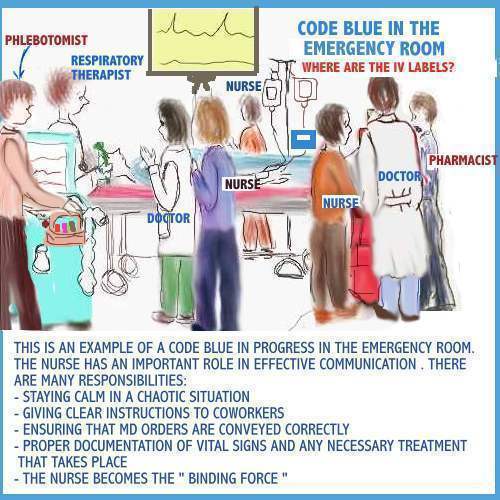
The image above shows a Code blue in progress. This is 
happening in the Emergency Room. Always follow your
Institution's policies and procedures for Code Blue. 

The role of the nurse who is assigned to the Code Blue

The nurse has an important role in effective communication.
There are many responsibilities.
- staying calm in a chaotic situation
- giving clear instructions to coworkers
- ensuring that MD orders are conveyed correctly
- proper documentation of vital signs and all treatments ,
  interventions that take place ( defibrillation for example)
  - the nurse becomes the " binding force.

Learn more about: The Nursing Process

Learn more about : Nursing communication

Common causes of medication errors


Like the artist perfects painting skills, so does the
nurse perfect clinical skills!

Sunday, October 17, 2010

ANTIEPILEPTIC DRUGS AND MORE

Updated 5/26
Dear nurses,

Dearnurses.net is no longer available.
New topics and links have been added below.


Scenario : Celeste is a 32 year old female, who is
pregnant for the first time. She is preeclamptic and
 is receiving a Magnesium Sulfate infusion. 
Her assessment shows she is hard to arouse.
Learn more, by clicking on the link :
Preeclampsia


What is PROM ( Premature Rupture of Membranes) 

This condition which typically occurs in the third trimester of
pregnancy, is also called " water breaking". The amniotic sac
which contains the baby, may rupture prematurely and amniotic 
fluid leaks out of the vagina. 

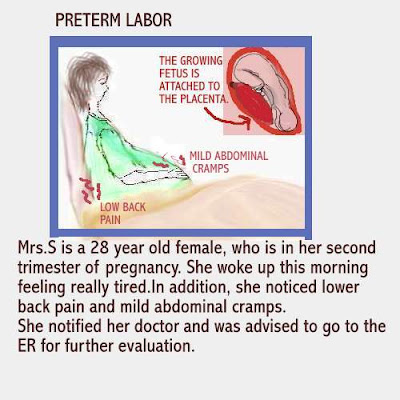
Scenario:  Mrs. S is a 28 year old who is in her second trimester of pregnancy.
She woke up feeling very tired. In addition, she noticed lower back pain and
mild abdominal cramps. She notified her doctor and was advised to go to the 
ER for further evaluation.
Learn more by clicking on the link:
Preterm labor

What is glioblastoma?

Gliobalstoma multiforme is a tumor. It can 
be treated through chemotherapy drugs like
Temozolmide (Temodar).

Side effects include: seizures, nausea, vomiting,
flu symptoms, and weight/hair loss.

Learn more by clicking on the link:
The New Nurse - Brain and spinal tumor


Learn more about: Multiple sclerosis

Learn more by clicking on the link:

In the image above, there are people taking a stroll
in the park. Although no one stops to think about 
each action that is taken, muscles, bones and joint
are at work.

The human body is made up of muscles, bones and 
joints of different sizes. Bones and joints have very
important work to do. They work in unity, to provide
support for the body, as well as protecting vital 
organs.

Learn more about: Muscles, bones and joints


Thursday, June 17, 2010

UNDERSTANDING PAC / SINUS ARRHYTHMIA

Updated 8/26Dearnurses.com is no longer available.
The image above, shows a patient who is awake
and oriented. He has a known cardiac history. His
cardiac monitor shows Sinus rhythm with PACs.

What is a PAC? 

PAC stands for Premature Atrial Contraction.
This is caused by an irritable focus in the atria.
PACs can occur in a healthy person and requires
no special treatment.

Causes include:
- Electrolyte imbalances
- Coronary Artery disease
- COPD, fever and more

Sinus Arrhythmia is a rhythm that may not
 require any special treatment.It is commonly
seen in athletes and small children. It is also
caused by drugs such as Digoxin. 
Learn more about this topic by watching
the video: 
The new nurse - Easy read EKG


Learn more about : The Circulatory System


Learn about : the ABG and Code Blue


Patient assessment is a very important tool. 
The patient having chest pain, would have 
an assessment done by the nurse.

A description of the pain, as well as pain
scales assessment ( 1-10) is usually done.
Documentation of intervention is also 
necessary. 
Below are more assessment links:
 Neurological assessment
Abdominal assessment 


Learn more about this topic by watching the video:


Saturday, October 26, 2013

THE NEW NURSE - ORGANIZATIONAL SKILLS IN THE CLINICAL SETTING

Updated 1/25
Dear nurses,

Hope you had a good week. Every nurse is either new
or was new to the profession.The challenges we face
can sometimes be overwhelming. Below are new links.


            Learn more about - Communication skills


What is Code Blue? 
Learn more about:  ( Cardiopulmonary Resuscitation)

It is important to follow your Institution's Policies
and Procedures and MD orders.
Learn more about: - organization skills in the
clinical setting


Please click on the link below to watch the video: