Dear Nurses

Friday, May 17, 2024

IDENTIFYING SEIZURES AND PATIENT SAFETY

What is a seizure?

A seizure is considered to be a sudden outburst of
uncontrollable electrical activity from the neurons
in the brain. Involuntary contraction of muscles
usually occur and last for a short period. Seizures
may vary in duration and frequency.

Types of seizures

Generalized ( grand mal ) seizure - can be seen
when a patient has sudden, jerky movements
throughout the body. A patient may fall to the
ground and have loss of consciousness. Types
of generalized seizures include: tonic, clonic
and myotonic.

A partial (focal ) seizure, is also sudden and
confined to one part of the body.
Postictal - following a seizure, a patient may
 stay in a stuporous state for some minutes.

EEG ( Electroencephalogram) A diagnostic test ,
which is done to monitor seizure activity. This
test is usually ordered by the doctor.

Patient safety during a seizure

When a seizure occurs, patient safety should
 be a major concern. A patient who has a 
history of seizures, should already be on
anticonvulsant medications.
"seizure precations " sign is usually
posted over the bed.

Here are some helpful hints:
- Follow MD orders
- Protect the patient from harm
- Maintaining a patent airway; turn head to the side, if necessary,
  to prevent airway obstruction
- Keeping bed rails up , to prevent the patient falling out of bed
- Monitoring duration and character of seizure
- After seizure, assessment and documentation of, vital signs, O2 saturation,
- notifying MD of patient status


It is important to protect the seizure patient from falling and getting injured.


Tuesday, July 28, 2009

SEIZURE ACTIVITY AND ITS CAUSES

                                     Dearnurses.com is no longer available.

Updated 4/25

Dear nurses,

New information about seizures and its causes, have been
added. See below.

What is a seizure?

A seizure is considered to be a sudden outburst of
uncontrollable electrical activity from the neurons
in the brain. Involuntary contraction of muscles
usually occur and last for a short period. Seizures
may vary in duration and frequency.


Patient safety during a seizure

When a seizure occurs, patient safety should
 be a major concern. A patient who has a 
history of seizures, should already be on
anticonvulsant medications.
"seizure precations " sign is usually
posted over the bed.

Here are some helpful hints:
- Follow MD orders
- Protect the patient from harm
- Maintaining a patent airway; turn head to the side, if necessary,
  to prevent airway obstruction
- Keeping bed rails up , to prevent the patient falling out of bed
- Monitoring duration and character of seizure
- After seizure, assessment and documentation of, vital signs, O2 saturation,
- notifying MD of patient status


The patient with preeclampsia is at risk for seizures.
Learn more by clicking on the Link: Preeclampsia


Learn more by clicking on the link: Hormones


Sunday, May 01, 2011

WHAT IS A STROKE ?


Updated 5/24
Dear nurses,

What is it ? is no longer available.

What is a stroke?
stroke is also known as a brain attack. 

Identifying strokes and treatment

A stroke may be hemorrhagic (caused by bleeding) or
ischemic (embolic) caused by a clot or plaque in a blood
vessel. 

Bleeding ( hemorrhagic) into the brain may be caused
by trauma or rupture of a blood vessel due to high
blood pressure. ICP monitoring may be necessary for 
the patient with a hemorrhagic stroke.

In the case of an embolic stroke, a blood clot may
obstruct the flow of blood in the brain. This will also
affect oxygen to the brain.

Embolic strokes are usually treated with drugs such
as TPA ( Tissue Plasminogenic Activator). Antihypertensive
drugs and anti- seizure medications may also be ordered.


TPA ( Thrombolytic Plasminogen Activator)
is not only used for reperfusion in patients
who had a myocardial infarction, it is also
used in the treatment of embolic strokes.


Can a stroke be prevented?
It is suggested that a stroke can be prevented. People who
smoke frequently, eat a diet rich in cholesterol foods and
do not exercise regularly, are considered to be at risk.

High blood pressure and obesity also puts someone at risk.
Lifestyle changes such as regular exercise, eating a diet with
fresh fruits and vegetables, as well as high fiber may help to
reduce stroke risk.


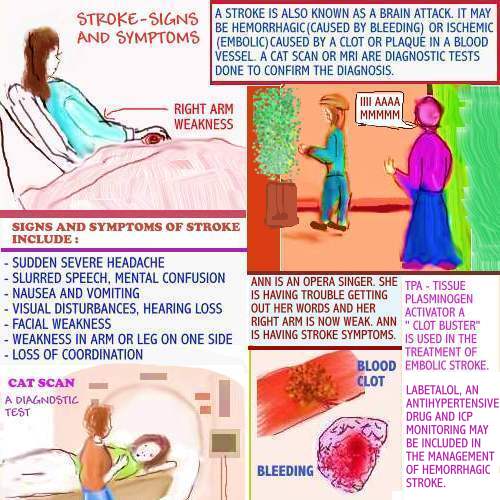
In the image above, Ann is an opera singer.
While on stage, she suddenly starts having
trouble getting her words out. Her right arm
also feels weak. These symptoms are classic
of stroke symptoms.

Severe headache, mental confusion, visual
disturbances and right or left sided weakness
may also occur.

Learn more : Stroke assessment 


Thursday, July 30, 2009

WHAT IS A STROKE?


What is a stroke?
A stroke is also known as a brain attack.

Identifying strokes and treatment

A stroke may be hemorrhagic (caused by bleeding) or
ischemic (embolic) caused by a clot or plaque in a blood
vessel. 

Bleeding ( hemorrhagic) into the brain may be caused
by trauma or rupture of a blood vessel due to high
blood pressure. ICP monitoring may be necessary for 
the patient with a hemorrhagic stroke.

In the case of an embolic stroke, a blood clot may
obstruct the flow of blood in the brain. This will also
affect oxygen to the brain.

Embolic strokes are usually treated with drugs such
as TPA ( Tissue Plasminogenic Activator). Antihypertensive
drugs and anti- seizure medications may also be ordered.

Reperfusion Therapy and its uses

Reperfusion Therapy is a form of treatment that
is used for patients who have a myocardial infarction
(MI) with STEMI. Typically, the patient with a
completely blocked coronary artery, would
demonstrate STEMI on the EKG.

TPA ( Thrombolytic Plasminogen Activator)
is not only used for reperfusion in patients
who had a myocardial infarction, it is also
used in the treatment of embolic strokes.


Dearnurses.com is no longer available.

Learn more about: Cranial nerves and 
Subarachnoid hemorrhage

Friday, May 16, 2008

SIMPLIFYING SEIZURES

Updated 11/25

Scenario: Chuck is a 34 year old male who was
admitted to the hospital for brain tumor resection.
He is suddenly having a  seizure.

What is a seizure?

A seizure is considered to be a sudden outburst of
uncontrollable electrical activity from the neurons
in the brain.

His lab values reveal hyponatremia ( low sodium).
Seizures may occur in the patient with hyponatremia.
Chuck's sodium was corrected with a doctor's order
of Normal Saline 3%.

It is difficult to predict exactly when a seizure may
occur. Learn more about: Seizures and safety


Learn more about : Neurological assessment


Learn more about : Stroke and ICP Monitoring

The plan of care should reflect how to maintain a 
safe environment and prevent any harm.
 Learn more about: Care planning

Saturday, February 14, 2026

INTERESTING FACTS ABOUT HEPARIN AND TPA ( THROMBOLYTIC PLASMINOGEN ACTIVATOR)


In the image above, a new nurse seeks information
about Heparin, an anticoagulant drug.

Heparin is an anticoagulant drug. It is used to
prevent clot formation in conditions such as 
Atrial fibrillation and DVT ( deep vein thrombosis).
Learn more about :Heparin Therapy


Heparin is given IV or SQ, but never via the intra-
muscular route. Side effects of anticoagulant therapy
include: bleeding of gums, hematuria, bleeding from IV
and dressing sites. Protamine Sulfate is the drug used to
counteract the action of Heparin.


A patient on Anticoagulation Therapy may experience 
bleeding of the gums, at dressing sites, in the urine, or
at IV sites. It is important for the nurse to assess and 
document any bleeding.


Poor circulation may occur for a number of reasons.
Any obstruction to the flow of blood may lead to conditions
such as stroke, heart failure, and or renal failure .The 
diabetic patient is also at risk.


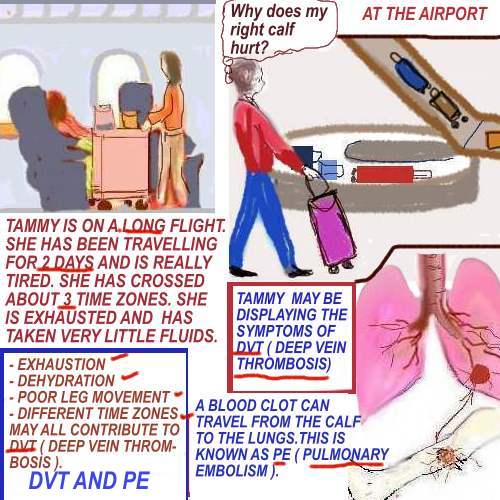
Learn more about : ARDS, DVT and PE


What is a stroke?
A stroke is also known as a brain attack.

Identifying strokes and treatment

A stroke may be hemorrhagic (caused by bleeding) or
ischemic (embolic) caused by a clot or plaque in a blood
vessel. 

Bleeding ( hemorrhagic) into the brain may be caused
by trauma or rupture of a blood vessel due to high
blood pressure. ICP monitoring may be necessary for 
the patient with a hemorrhagic stroke.

In the case of an embolic stroke, a blood clot may
obstruct the flow of blood in the brain. This will also
affect oxygen to the brain.

Embolic strokes are usually treated with drugs such
as TPA ( Tissue Plasminogenic Activator). Antihypertensive
drugs and anti- seizure medications may also be ordered.


Reperfusion Therapy and its uses

Reperfusion Therapy is a form of treatment that
is used for patients who have a myocardial infarction
(MI) with STEMI. Typically, the patient with a
completely blocked coronary artery, would
demonstrate STEMI on the EKG.

TPA ( Thrombolytic Plasminogen Activator)
is not only used for reperfusion in patients
who had a myocardial infarction, it is also
used in the treatment of embolic strokes.

Thursday, May 28, 2009

UNDERSTANDING STROKE SYMPTOMS

Updated 6/25


In the image above, Ann is an opera singer.
While on stage, she suddenly starts having
trouble getting her words out. Her right arm
also feels weak. These symptoms are classic
of stroke symptoms.

Severe headache, mental confusion, visual
disturbances and right or left sided weakness
may also occur.

CAT scan or MRI are diagnostics tests that
are done to confirm the diagnosis. 


What is a stroke?
A stroke is also known as a brain attack.

Identifying strokes
A stroke may be hemorrhagic (caused by bleeding) or
ischemic (embolic) caused by a clot or plaque in a blood
 vessel. Bleeding into the brain may be caused by trauma 
or rupture of a blood vessel due  to high blood pressure. 

In the case of an embolic stroke, a blood clot may obstruct
the flow of blood in the brain. This will also affect oxygen
to the brain. 

Embolic strokes are usually treated with drugs such as
 TPA ( Tissue Plasminogenic Activator). Antihypertensive
drugs and anti seizure medications may also be ordered.

Dearnurses.com is no longer available.

Learn more about: Stroke for the layperson

Friday, May 16, 2008

SIMPLIFYING SEIZURES

Updated 9/25

Dearnurses.net is no longer available.
New information has been added below.


What is a seizure?

A seizure is considered to be a sudden outburst of
uncontrollable electrical activity from the neurons
in the brain.
Learn more about: Seizures


Learn more about: Care planning


Learn more about: Why Therapy and The Aging Process

Friday, April 20, 2007

WHAT IF YOUR PATIENT HAS A BLEED INTO THE BRAIN?

Updated 6 /25
Dear nurses,

Dearnurses.com is no longer available. 


                  Learn more about: Repair of an aneurysm
                                                   

IF YOUR PATIENT HAS A BLEED, HERE ARE SOME HELPFUL HINTS:
- follow MD orders.
- closely monitor neuro status and document findings
- monitor for possible seizure activity.
- monitor vital signs and oxygen saturation. 
- medicate for pain and document results. Encourage patient to rest ,
  as this will decrease the need for lots of pain medication. Too much
  pain medication may mask any changes in neurological status.

It is important to educate family members about the need for rest ,
 as this will decrease the need for too much pain medication.
 A decrease in stimulation, helps.

Learn more about: Subarachnoid hemorrhage


Learn more about: Stoke and its prevention