Dear Nurses

Thursday, May 20, 2010

ADDRESSING FETAL DISTRESS / ABRUPTIO PLACENTA

                         Dearnurses.net is no longer available.

Updated 1/25
Dear nurses,

Prolapse of the umbilical cord during pregnancy
may be a complication of breech birth. In breech
presentation, the fetus faces the opposite direction.

Fetal distress may have many causes, these include:
- prolapse of the umbilical cord
- IV Pitocin used to induce labor
Cesarean section may be necessary to avoid distress
of the baby.


The image above shows, Mrs.S who is about six months pregnant.
She is relaxing at home. Suddenly, she starts to have abdominal 
and back pain. She is also beginning to experience bleeding.

The placenta is a very vascular organ that develops in the
 uterus of a woman during pregnancy. It is attached to the 
fetus by the umbilical cord and provides nourishment and
oxygen to the growing fetus.

When the placenta suddenly becomes detached from the uterus,
either by trauma , or unknown cause, it is called placenta abruptio.
Heavy vaginal bleeding , abdominal cramping and signs and
symptoms of shock may be present.

Abruptio placenta requires emergency care. Placental separation 
occurs. C-section is usually done.


Saturday, June 21, 2008

ADDRESSING ABRUPTIO PLACENTA

Updated 5/24
Dear nurses,

The image above shows, Mrs.S who is about six months pregnant.
She is relaxing at home. Suddenly, she starts to have abdominal 
and back pain. She is also beginning to experience bleeding.

The placenta is a very vascular organ that develops in the
 uterus of a woman during pregnancy. It is attached to the 
fetus by the umbilical cord and provides nourishment and
oxygen to the growing fetus.

When the placenta suddenly becomes detached from the uterus,
either by trauma , or unknown cause, it is called placenta abruptio.
Heavy vaginal bleeding , abdominal cramping and signs and
symptoms of shock may be present.

Abruptio placenta requires emergency care. Placental separation 
occurs. C-section is usually done.


Nursing responsibilities for the newborn

Immediately following birth, armbands are placed 
on both mother and baby. A physical assessment is
 done and the baby's vital signs, birth weight, head,
and chest circumferences are all documented.

Reflexes in the newborn

The palmar reflex is what causes the neonate to grasp
 with the fingers, when the palm of the hand is stroked.

Rooting and sucking reflexes are present at birth.
They cause the neonate to suck.

Additional newborn facts
:
- A newborn's heart rate averages between 120-160 beats per minute.
- A newborn's respirations average between 35-60 breaths per minute.
- It is important to note that a newborn's neck is short and the neck
muscles are weak. The nurse should be aware of supporting this area
carefully.

The Clinical setting Step by Step is no longer available.
Learn more, by clicking on the links below: 


Monday, July 17, 2006

IDENTIFYING ABRUPTIO PLACENTA AND THE CARE PLAN


Updated 3/25

The image above shows, Mrs.S who is about six months pregnant.
She is relaxing at home. Suddenly, she starts to have abdominal 
and back pain. She is also beginning to experience bleeding.

The placenta is a very vascular organ that develops in the
 uterus of a woman during pregnancy. It is attached to the 
fetus by the umbilical cord and provides nourishment and
oxygen to the growing fetus.

When the placenta suddenly becomes detached from the uterus,
either by trauma , or unknown cause, it is called placenta abruptio.
Heavy vaginal bleeding , abdominal cramping and signs and
symptoms of shock may be present.

Abruptio placenta requires emergency care. Placental separation 
occurs. C-section is usually done.

The care plan for each patient , is a reflection of the
information provided about the history and MD's 
diagnosis.

For more updated topics, please click on the links below:

Sunday, November 15, 2009

MATERNAL NURSING -ESTROGEN AND PROGESTERONE


Estrogen and Progesterone are two hormones produced
by the ovaries initially, then the placenta in the latter part
of pregnancy. They are first produced by the ovaries and
later the placenta. Estrogen and Progesterone also keep
the placenta healthy and enhances lactation.


The image above shows, Mrs.S who is about six months pregnant.
She is relaxing at home. Suddenly, she starts to have abdominal 
and back pain. She is also beginning to experience bleeding.

The placenta is a very vascular organ that develops in the
 uterus of a woman during pregnancy. It is attached to the 
fetus by the umbilical cord and provides nourishment and
oxygen to the growing fetus.

When the placenta suddenly becomes detached from the uterus,
either by trauma , or unknown cause, it is called placenta abruptio.
Heavy vaginal bleeding , abdominal cramping and signs and
symptoms of shock may be present.

Abruptio placenta requires emergency care. Placental separation 
occurs. C-section is usually done.


Learn more about : Magnesium infusion


Scenario: Pam has been admitted to the hospital
with complaints of abdominal pain over a period
of time. The doctor has decided to do an ERCP
( Endoscopic Retrograde Cholangiopancreatography)
for this questionable abdominal pain.

This will be reflected in the care plan.


Learn more about : Triage Nurse


It is important to recognize the importance 
of being a safe nurse. Linda's story continues :


Saturday, October 17, 2009

SIMPLIFYING MATERNAL NURSING


Updated 12/24              Dearnurses.net is no longer available.
Dear nurses,


Scenario: Megan is 12 weeks pregnant.
She has been vomiting once or twice
daily and is beginning to feel weak
and tired. Learn more by clicking on the link:

Estrogen and Progesterone are two hormones
produced by the ovaries initially, then the placenta 
in the latter part of pregnancy. 

They are first produced by the ovaries and later
the placenta. Estrogen and Progesterone also
keep the placenta healthy and enhance lactation.


The image above shows, Mrs.S who is about six months pregnant.
She is relaxing at home. Suddenly, she starts to have abdominal 
and back pain. She is also beginning to experience bleeding.

The placenta is a very vascular organ that develops in the
 uterus of a woman during pregnancy. It is attached to the 
fetus by the umbilical cord and provides nourishment and
oxygen to the growing fetus.

When the placenta suddenly becomes detached from the uterus,
either by trauma , or unknown cause, it is called placenta abruptio.
Heavy vaginal bleeding , abdominal cramping and signs and
symptoms of shock may be present.

Abruptio placenta requires emergency care. Placental separation 
occurs. C-section is usually done.


In the image above, a 32 year old female is
pregnant for the first time. She is preeclamptic
and is receiving Magnesium via IV infusion.
She is lethargic and hard to arouse.
Learn more about : Magnesium infusion

Saturday, July 19, 2008

ADDRESSING FEBRILE SEIZURES

Updated 7/26

Dear nurses,
Dearnurses.net is no longer available.
New information and links have been 
added below.


The image above shows, Mrs.S who is about six months pregnant.
She is relaxing at home. Suddenly, she starts to have abdominal 
and back pain. She is also beginning to experience bleeding.

The placenta is a very vascular organ that develops in the
 uterus of a woman during pregnancy. It is attached to the 
fetus by the umbilical cord and provides nourishment and
oxygen to the growing fetus.

When the placenta suddenly becomes detached from the uterus,
either by trauma , or unknown cause, it is called placenta abruptio.
Heavy vaginal bleeding , abdominal cramping and signs and
symptoms of shock may be present.

Abruptio placenta requires emergency care. Placental separation 
occurs. C-section is usually done.


In the image above, a 32 year old female is
pregnant for the first time. She is preeclamptic
and is receiving Magnesium via IV infusion.
She is lethargic and hard to arouse.
Learn more about : Magnesium infusion


Thursday, November 26, 2009

IDENTIFYING AMNIOCENTESIS AND ABRUPTIO PLACENTA


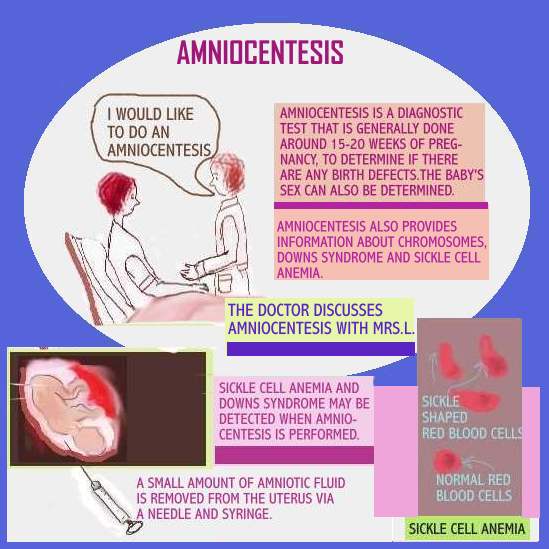
In the image above, the doctor discusses the need
for an Amniocentesis with a pregnant patient.

What is Amniocentesis?

Amniocentesis is a Diagnostic test that is generally
done around 15-20 weeks of pregnancy. It helps to
provide information about chromosomes, Downs
Syndrome and sickle cell anemia.

The image above shows, Mrs.S who is about six months pregnant.
She is relaxing at home. Suddenly, she starts to have abdominal 
and back pain. She is also beginning to experience bleeding.

The placenta is a very vascular organ that develops in the
 uterus of a woman during pregnancy. It is attached to the 
fetus by the umbilical cord and provides nourishment and
oxygen to the growing fetus.

When the placenta suddenly becomes detached from the uterus,
either by trauma , or unknown cause, it is called placenta abruptio.
Heavy vaginal bleeding , abdominal cramping and signs and
symptoms of shock may be present.


Learn more about : Magnesium infusion

Thursday, December 31, 2009

HAPPY NEW YEAR NURSES - LEARN MORE ABOUT MATERNAL NURSING

Happy New Year to all nurses!
Dearnurses.net is no longer available.

Updated 8/26


Prolapse of the umbilical cord during pregnancy
may be a complication of breech birth. In breech
presentation, the fetus faces the opposite direction.

Fetal distress may have many causes, these include:
- prolapse of the umbilical cord
- IV Pitocin used to induce labor
Cesarean section may be necessary to avoid distress
of the baby.


In the image above, a 32 year old female is
pregnant for the first time. She is preeclamptic
and is receiving Magnesium via IV infusion.
She is lethargic and hard to arouse.
Learn more about : Magnesium infusion


Learn more about:  Seizures and safety


Thursday, January 21, 2021

IDENTIFYING DIC ( DISSEMINATED INTRAVASCULAR COAGULATION)

Updated 12/25

What is DIC?

DIC (Disseminated Intravascular Coagulation)

DIC is a hemorrhagic syndrome. There is an
obvious 
disturbance in the clotting mechanism
in the blood. 
Platelets and fibrin have lost their
ability to clot.

 Internal hemorrhage occurs and a serious
continuation 
of bleeding throughout the body
 begins. The 
liver is also involved in clotting.

Treatment is directed at correcting the clotting 
factors involved. Blood transfusion may be
necessary. Hemodynamic monitoring  is
necessary. 

DIC is sometimes brought on secondary to other
medical conditions, examples are:trauma, sepsis,
abruptio placenta renal failure and more.

Learn more about : The hormonal effect

Learn more by clicking on the link:
Sepsis an overview
Sessions 46


Learn more about: PTSD

and The immune System


Relaxation is a beautiful thing. It decreases
anxiety and helps to reduce stress.


Thursday, July 20, 2006

Disseminated Intravascular Coagulation

 Updated 12/25

DIC (Disseminated Intravascular Coagulation)

DIC is a hemorrhagic syndrome. There is an
obvious 
disturbance in the clotting mechanism
in the blood. 
Platelets and fibrin have lost their
ability to clot.

 Internal hemorrhage occurs and a serious
continuation 
of bleeding throughout the body
 begins. The
liver is also involved in clotting.

Treatment is directed at correcting the clotting 
factors involved. Blood transfusion may be
necessary. Hemodynamic monitoring  is
necessary. 

DIC is sometimes brought on secondary to other
medical conditions, examples are:trauma, sepsis,
abruptio placenta renal failure and more.

Please click on the new links, for more information: