Dear Nurses

Wednesday, September 16, 2026

LINK TO COMMON CAUSES OF MEDICATION ERRORS

 Dear nurses,

There seems to be a problem with the old
link to: Common causes of medication errors.

The one above is new and should work well.

Tuesday, June 11, 2013

ADDRESSING THE EMERGENCY ROOM


The Emergency Room is an important part
of any hospital, for a number of reasons.
Any patient with an emergent situation will
need intervention in this area.

The nurse has an important role to play with
assessment and following MD orders for
treatment and transfer to the appropriate unit
in the hospital, or to discharge the patient.

Above, the nurse is doing an assessment on
a patient in hypovolemic shock, following
trauma. Signs and symptoms include:
- rapid respirations 
- rapid heart rate
- cool, clammy skin

It takes "all hands on deck" to complete the work.

It is important to recognize that classroom skills
are different from clinical skills. A nurse's
performance in the work place takes on a different 
challenge from the classroom.

Learn more about: Hemodynamic Monitoring and


Learn more about: 

Common causes of medication errors

 IV infiltration may cause damage to the skin and
surrounding tissue.Learn more about: IV 

Tuesday, August 11, 2009

NEW NURSE - DO YOU KNOW HOW TO ORGANIZE YOUR DAY?

Updated 8/26

Dear nurses,
Dearnurses.com is no longer available.
New information has been added below.

A nurse's priorities

When a nurse's priorities are wrong

In the image above, Jenna is a new nurse.
She has not fully understood the importance
of safe nursing practices.

Her desperation to be on time to meet a friend
for lunch, took priority over patient safety.

Jenna works in the ICU. The monitor alarm 
of the patient in her care, was going off. She
made no attempt to check if something was
wrong.

It is important to understand that a patient who
is cared for in the ICU, requires a higher level
of care.

It is unfortunate Jenna did not prioritize.


   Helpful information for the clinical nurse


  In the image above, Lynn is a new graduate who
  is full of expectation. She arrives early on her new
  unit. But her hopes are shattered when her preceptor
  suggested that she is too busy to do an orientation.

It is unfortunate, but this does happen on occasion.
Although Lynn is off to a rough start, there are some
things she can do to make her situation easier.
Learn more by clicking on the links below:

    The role of the Preceptor 
A Preceptor has a very important role to play in
training new nurses. Typically, a nurse who is 
assigned to this role, has a significant number of
years of experience and is able to utilize the learned
skills in a meaningful way.

The role of a preceptor often impacts the way a new 
nurse sees the nursing profession and may even have
an effect on what is expected.


Learn more about : Organizational skills

It takes "all hands on deck" to complete the work.

It is important to recognize that classroom skills
are different from clinical skills. A nurse's
performance in the work place takes on a different 
challenge from the classroom.

Learn more about: Hemodynamic Monitoring and


Learn more about: 
An intravenous infusion may be started in a peripheral

Learn more by clicking on the link:
IV assessment


Friday, February 07, 2025

COMMON CAUSES OF MEDICATION ERRORS


When a patient is admitted to a healthcare facility, 
 information such as allergies, past medical history,
 height, weight and medications taken, are all recorded.

This type of information is very important, as it will help
 the doctor when prescribing medications. It will also be
of use to the pharmacist with providing correct drug dosages.

Regardless of where a nurse works, medication administration 
 is done.The nurse who gives drugs of any kind, should take time, 
to ensure that everything is done correctly.

 Learn more: Nursing fundamentals

Helpful information for the clinical nurse


                               Clinical judgement         

Here are some of the ways in which medication
errors may occur:
-Misreading MD orders. If the nurse is uncertain
about an order , it is best to communicate with the
doctor or pharmacist.   
-   Poor communication of information, for example,
   when a patient is  transferred from one unit to
  another.
  - Improper dilution of medication ( always check
  the manufacturer's instructions for proper dilution). 
 - Drug incompatibility: An example - Dilantin
   can only be mixed with  Normal Saline.
- Confusing one drug with another, as some
    drugs have similar names.


Monday, September 14, 2026

COMMON CAUSES OF MEDICATION ERRORS


When a patient is admitted to a healthcare facility, 
 information such as allergies, past medical history,
 height, weight and medications taken, are all recorded.

This type of information is very important, as it will help
 the doctor when prescribing medications. It will also be
of use to the pharmacist with providing correct drug dosages.

Regardless of where a nurse works, medication administration 
 is done.The nurse who gives drugs of any kind, should take time, 
to ensure that everything is done correctly.

 Learn more: Nursing fundamentals

Helpful information for the clinical nurse


                               Clinical judgement         

Here are some of the ways in which medication
errors may occur:
-Misreading MD orders. If the nurse is uncertain
about an order , it is best to communicate with the
doctor or pharmacist.   
-   Poor communication of information, for example,
   when a patient is  transferred from one unit to
  another.
  - Improper dilution of medication ( always check
  the manufacturer's instructions for proper dilution). 
 - Drug incompatibility: An example - Dilantin
   can only be mixed with  Normal Saline.
- Confusing one drug with another, as some
    drugs have similar names.

Wednesday, April 17, 2024

COMMON CAUSES OF MEDICATION ERRORS


 When a patient is admitted to a healthcare facility, 
 information such as allergies, past medical history,
 height, weight and medications taken, are all recorded.

This type of information is very important, as it will help
 the doctor when prescribing medications. It will also be
of use to the pharmacist with providing correct drug dosages.

Regardless of where a nurse works, medication administration 
 is done.The nurse who gives drugs of any kind, should take time, 
to ensure that everything is done correctly.

 Learn more: Nursing fundamentals


Helpful information for the clinical nurse

 Here are some of the ways in which errors may occur:
- Misreading MD orders. If the nurse is uncertain about
an order , it is best to communicate with the doctor or
pharmacist.                                     
 - Poor communication of information, for example
when a patient is  transferred from one unit to another
 - Improper dilution of medication ( always check
the manufacturer's instructions for proper dilution).
 - Drug incompatibility : an example - Dilantin is mixed with
Normal Saline.                          
- Confusing one drug with another, as some drugs have similar
  names.
- Distraction, like having a conversation while administering
 medications .             
 - Forgetting to document medications when given.                                              


Saturday, March 15, 2008

THE CLINICAL SETTING STEP BY STEP

Updated 12/24

Dear nurses,
The Clinical Setting Step by Step is no longer available.
New information is provided below.

Regardless of where a nurse works, doing good communication
skills, assessment tools and sound clinical judgment are all part
of a days work. Learn more: Here


The nurse above is about to make a medication error.
This is very poor judgement on her part.
Here are some helpful pointers for good medication administration:
- Follow MD orders
- Remember the five or more rights
- DO NOT USE COLOR CODING AS YOUR ONLY GUIDELINE.
Remember, many pills may have the same color, but that does not
mean they are of equal strength.
- If you are a new nurse and you are uncertain, consult with a more
 experienced nurse to help you out.
- Always follow your Institution's policies and procedures


Learn more about: Communication skills


Friday, October 13, 2006

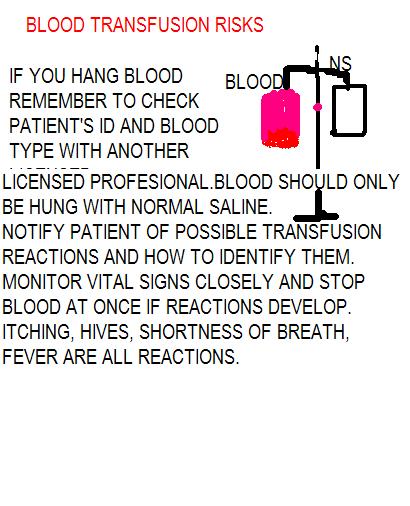
BLOOD TRANSFUSION REACTION/ MEDICATION ERRORS

Updated 2/25
Possible signs of blood transfusion reaction:
Anxiety, chills, flushing, itching, shortness of breath
and chest pain.


A blood transfusion may be fatal. It is important
to make every attempt to check for any prior history
of blood transfusion reaction. 

Helpful hint: Discuss with the patient what kind of
reaction is possible and how to call for help. Always
follow your Institution's policies and procedures /MD
orders.Learn more about  : PACU


Learn more about: MRI

Tuesday, January 25, 2011

PHARMACOLOGY FOR NURSES IN THE CLINICAL SETTING

Updated 1/26          Dearnurses.net is no longer available.

Dear nurses,


The nurse above is about to make a medication error.
This is very poor judgement on her part.
Here are some helpful pointers for good medication administration:
- Follow MD orders
- Remember the five or more rights
- DO NOT USE COLOR CODING AS YOUR ONLY GUIDELINE.
Remember, many pills may have the same color, but that does not
mean they are of equal strength.
- If you are a new nurse and you are uncertain, consult with a more
 experienced nurse to help you out.
- Always follow your Institution's policies and procedures


Learn more about: Communication skills


Friday, January 30, 2009

PATIENT ASSESSMENT

Dearnurses.com is no longer available.
New topics with links have been added below.
Patient assessment is a very important tool. 
The patient having chest pain, would have 
an assessment done by the nurse.

A description of the pain, as well as pain
scales assessment ( 1-10) is usually done.
Documentation of intervention is also 
necessary. 
Below are more assessment links:
 Neurological assessment
Abdominal assessment 


Learn more about: 

An intravenous infusion may be started in a peripheral
site or a central line site.

Learn more by clicking on the link:
IV assessment


Thursday, April 15, 2010

HELPFUL INFORMATION ABOUT PHARAMCOLOGY FOR NURSES

Dearnurses.net is no longer available.

Updated 9/26

Dear nurses,
New topics and links have been added below.

Common causes of medication errors


Like the artist perfects painting skills, so does the
nurse perfect clinical skills!


Patient assessment is a very important tool. 
The patient having chest pain, would have 
an assessment done by the nurse.

A description of the pain, as well as pain
scales assessment ( 1-10) is usually done.
Documentation of intervention is also 
necessary. 
Below are more assessment links:
 Neurological assessment
Abdominal assessment 


Saturday, June 21, 2008

AVOIDING MEDICATION ERRORS


In the image above, Sara is new and afraid to "look stupid".
She is going to administer Potassium Chloride IM instead 
of IVPB ( IV piggy back).

A medication error can happen at anytime. Every attempt
should be taken by the nurse, to avoid it happening. if you
are uncertain,  try to ask someone else or the pharmacist.
Learn more : Common causes of medication errors 


Scenario 1: Lynn is a new RN. Her preceptor did not
do a good job explaining the correct way to do an 
assessment. Lynn is not aware of the mistake she
is about to make.