Dear Nurses

Wednesday, April 08, 2020

UNDERSTANDING ANESTHETICS - AN OVERVIEW

Updated 7/25


General anesthetics are usually given prior to surgery
IV drugs such as Opiates(Fentanyl), Benzodiazepines
(Midazolam), Barbiturates (Thiopental), Hypnotics
(Propofol), are some examples of the medications used
to put patients to sleep.

It is important to remember that the aftermath of receiving
anesthetics agents will vary from one patient to the next.
Even under the best circumstances, some patients may be
more sensitive than others.

Some patients may report feelings of fear and hallucinations
after certain medications are given.


Learn more about: Reconstructive surgery


Learn more about: The Postoperative Patient

Here are some diagnostic tests that are done frequently.
Follow the links below:

1. Chest X ray
2. CAT scan
3. EKG
4. MRI scan
5. Ultrasound
6. Echocardiogram

Falls should be avoided at all costs!

Tuesday, April 13, 2010

FROM PREPARATION FOR THE OPERATING ROOM TO POST ANESTHESIA CARE UNIT

Updated 7/26

                                               The Operating Room
 
 Prior to surgery, extreme measures are taken to prevent the
spread of infection. The surgical team spend a significant
length of time scrubbing up. In addition, sterile gowns and 
gloves are worn. Masks are used over the nose and mouth.

The operating room has been cleansed sterilely. The patient
has also been prepped, as ordered by the doctor.

General anesthetics are usually given prior to surgery
IV drugs such as Opiates(Fentanyl), Benzodiazepines
(Midazolam), Barbiturates (Thiopental), Hypnotics
(Propofol), are some examples of the medications used
to put patients to sleep.

It is important to remember that the aftermath of receiving
anesthetics agents will vary from one patient to the next.
Even under the best circumstances, some patients may be
more sensitive than others.

Some patients may report feelings of fear and hallucinations
after certain medications are given.


Learn more about: Reconstructive surgery


Dearnurses.net is no longer available.

Following surgical intervention in the OR, patients 
are transferred to PACU. They are closely monitored
for a period of time, then discharged home or to
another unit.

 During that time, medications may be given for pain, 
hypertension, elevated or low blood sugar and more.
The doctor orders the appropriate medications and IV
fluids.


Learn more about: The Postoperative Patient


Sunday, September 16, 2012

AN OVERVIEW OF GENERAL ANESTHETICS


Updated 9/25

Dear nurses,


General anesthetics are usually given prior to surgery
IV drugs such as Opiates(Fentanyl), Benzodiazepines
(Midazolam), Barbiturates (Thiopental), Hypnotics
(Propofol), are some examples of the medications used
to put patients to sleep.


Learn more about: PACU


Learn more about : Neurological assessment


The nurse should take the time to  assess an IV site that is
swollen and painful. It may be necessary to  change the site,
 in order to prevent further tissue damage.

Learn more about : IV assessment and care


Saturday, March 15, 2008

PARALYTIC ILEUS IN REVIEW.


Updated 2 /26

Scenario: In the image above, Alice had abdominal
surgery 3 days ago. She has no audible bowel sounds
and is complaining of severe abdominal pain.

What is Paralytic Ileus?

A paralytic ileus is a postoperative complication.
It may occur in any surgical patient and is caused
by anesthetics.

What are some of the symptoms of this condition?
Absent bowel sounds, abdominal pain and distention.

Please watch the video: Bowel obstruction


Scenario: Emma is in the doctor's office with complaints 
of abdominal pain, diarrhea and flatulence.The nurse takes
a history and does an assessment.

What is IBS? 

Irritable Bowel Syndrome is a digestive disorder
that is diagnosed based on symptoms. It disrupts 
the normal pattern of the digestive system and is
sometimes brought on by stress related situations.

ABDOMINAL ASSESSMENT
 This is done by:
- inspection
- auscultation
- percussion and palpation

Preparation for ERCP (Cholangiopancreatography)

Learn more: What is an ERCP?


Scenario: Pam has been admitted to the hospital
with complaints of abdominal pain over a period
of time. The doctor has decided to do an ERCP
( Endoscopic Retrograde Cholangiopancreatography)
for this questionable abdominal pain.

This will be reflected in the care plan.


Thursday, January 26, 2012

THE SURGICAL PATIENT

Updated 7/25


PACU ( Post Anesthesia Care Unit)

Following surgical intervention, a patient is transferred
to an area known as PACU. . Upon arrival, a nurse will
 reorient the patient to his surroundings and do an
 assessment. 

The nurse will also follow MD orders regarding: 
- monitoring vital signs and oxygen saturation,
- administer pain medication, replace IV fluids,
- check dressings at surgical sites for bleeding 
- check drainage tubes and carry out any other


Paralytic ileus is a postoperative complication.
It may occur in any post surgical patient. It is
caused by anesthetics.

Absent bowel sounds, abdominal pain and distention
are signs of an ileus. It is important to check for bowel
sounds in the postoperative period.

Documentation is also important. If there are no bowel
sounds, MD should be notified for further orders.The
doctor orders tests such as X-Ray and CT scan  to confirm
diagnosis. Insertion of a nasogastric tube is also ordered by MD .


DKA may lead to dehydration. Learn more : DKA

The trauma patient is at risk for dehydration.
Learn more :Trauma

Saturday, May 12, 2007

PARALYTIC ILEUS


Paralytic ileus is a postoperative complication. It may occur in any 
post surgical patient. It is caused by anesthetics.

What are some of the symptoms of this condition?
Absent bowel sounds, abdominal pain and distention.

It is important to check for bowel sounds in the postoperative period.
Documentation is also important. 
If there are no bowel sounds, MD should be notified for further orders.

The doctor orders tests such as X-Ray and CT scan  to confirm diagnosis. 
Insertion of a nasogastric tube is also ordered by MD .


PARALYTIC ILEUS


A paralytic ileus is a postoperative complication.
It may occur in any surgical patient and is caused
by anesthetics.

Absent bowel sounds, abdominal pain and distention
usually occur. Learn more about this topic by clicking 
on the link: Bowel obstruction.


Scenario: Alice had surgical intervention and developed
a paralytic ileus. Her doctor ordered insertion of a naso-
gastric tube to suction , IV fluids and correction of electrolytes 
if necessary. 

Her nurse shares what the doctor ordered to help relieve 
the abdominal discomfort. Her progress will be monitored 
and documented.

WHAT IF YOUR PATIENT HAD AN ILEUS

Updated 5/25


A paralytic ileus may develop, after surgical intervention. 
Enjoy watching the video : Bowel obstruction


Paralytic ileus is a postoperative complication. It may occur in any 
post surgical patient. It is caused by anesthetics.

What are some of the symptoms of this condition?
Absent bowel sounds, abdominal pain and distention.

It is important to check for bowel sounds in the postoperative period.
Documentation is also important. 
If there are no bowel sounds, MD should be notified for further orders.

The doctor orders tests such as X-Ray and CT scan  to confirm diagnosis. 
Insertion of a nasogastric tube is also ordered by MD .

Sunday, June 04, 2006

POSTOPERATIVE CARE

Updated 4/25

The postoperative patient is faced with many challenges.
The nurse is responsible for not only assessing , but also
documenting and notifying the doctor with any significant
changes like bleeding that may occur.

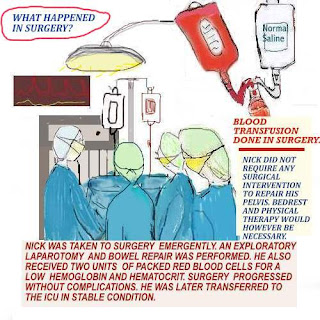
Below is a Mini Casr Study that demonstrates what happens
to a trauma patient before and after surgery.


Scenario: Nick is a 21 year old male, who was on his way 
to work , when he became involved in a head on collision.
Someone called 911 and paramedics arrived on scene, to
resuscitate him. See link below.


What is Paralytic Ileus?
A paralytic ileus is a postoperative complication.
It may occur in any surgical patient
and is caused by anesthetics.

Absent bowel sounds, abdominal pain and distention.
Learn more, by clicking on the link: Bowel obstruction


The surgical patient is at risk for: hypothermia, dehydration,
postoperative pneumonia , DVT , paralytic ileus or a cardiac
event. Pain management should not be overlooked.