Dear Nurses

Saturday, January 11, 2014

CLINICAL SCENARIOS AND QUIZZES FOR NURSES


     CLINICAL SCENARIOS AND QUIZZES FOR NURSES
                         
Updated 6 /26
Dear nurses, 
Dearnurses.com is no longer available.
              
 A nurse whether experienced or new, may be presented
 with an unfamiliar work situation.These clinical scenarios
 are intended  to help nurses expand their learning curve.


  Here are some examples of situations a new nurse
  might face:
- working in the ER and caring for someone
   with a Le Forte fracture
 a new nurse sent to work in the ICU and has a
    doctor's order to check Cranial nerves 3, 4 and 6
- a new nurse checking for a Halo ring after a basal
  skull fracture
- the doctor orders a Magnesium drip a patient is
   Many more topics and quizzes are included -
  Maternal, Cardiac and hormones 


A skiing accident and admission to ICU

In the image above, a skiing accident has occurred.
The injured person  is admitted to the ICU. ICP
monitoring has been set up. Family members have
arrived and cannot make sense of what is happening.

The staff members have not taken the time to explain
what has taken place.

When taking care of a patient who has experienced 
a traumatic event, the nurse should explain to the
family, what is being done. It may become necessary,
to get help from other staff members to help with 
communication.

Helpful suggestion:

Patient and family education should always
be included in the plan of care. The nurse is
responsible for initiating and updating the
care plan. 


Friday, December 28, 2007

BASAL SKULL FRACTURE


Updated 1/25
Dear nurses, 
Dearnurses.com is no longer available.Learn more about 
ICP monitoring by clicking on the link: ICP monitoring


Basal skull fractures are usually diagnosed by CAT scan. 
They are difficult to see on X-Ray. The image above,
shows what the patient with a basal skull may look like.


It is important to be able to identify the signs of a basal
skull fracture.The crack in the base of the skull may cause
CSF ( cerebrospinal fluid) to leak from the nose or ear. 
A halo ring may appear on the pillow. Cranial nerves
may also be damaged.

 For more helpful information, please click on the links:


SIMPLIFYING BASAL SKULL FRACTURE


Basal skull fractures are usually diagnosed by CAT scan.
They are difficult to see on X-Ray. The image above,
shows what the patient with a basal skull may look like.

It is important to be able to identify the signs of a basal
skull fracture.The crack in the base of the skull may cause
CSF ( cerebrospinal fluid) to leak from the nose or ear.
A halo ring may appear on the pillow. Cranial nerves
may also be damaged.

For more helpful information, please click on the links:
and enjoy learning. 
Updated 4 /23
Learn more about : Clinical judgement 

Tuesday, August 17, 2010

WHAT DOES IT MEAN ? NEUROLOGICAL VOCABULARY

Updated 8/26

Dear nurses,

Dearnurses.com is no longer available.
New information and links have been added below.

Basal skull fracture - What is it?
A basal skull fracture is usually diagnosed by CAT scan. 
It is very difficult to see on X-Ray. The image below,
shows what the patient with a basal skull may look like.

Basal skull fracture

It is important to be able to identify the signs of a basal
skull fracture.The crack in the base of the skull may cause
CSF ( cerebrospinal fluid) to leak from the nose or ear. 
A halo ring may appear on the pillow. Cranial nerves
may also be damaged.

 For more helpful information, please click on the links:


Here are some examples of neurological vocabulary:

Q -What is the normal distance for testing visual acuity?
A- 14-20 feet away.

Q - What does stereognosis mean?
A- The ability to identify objects by touching.

Q - What part of the brain is responsible for balance
and coordination?
A- The cerebellum, which lies below the cerebrum.

Q- What does word salad mean?
A- A collection of words that have no real meaning.

Q- What is anisocoria?
A- Unequal pupils which occur in about 20% of the 
population


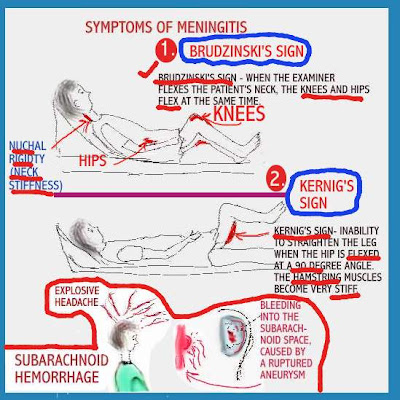
Brudzinski's and Kernig's signs are seen in patients
who have Meningitis or Subarachnoid hemorrhage.

Brudzinski's sign -When the examiner flexes the patient's
neck
, the knees and hips flex at the same time.
Kernig's sign - inability to straighten the leg when the 
hip is flexed at a 90 degree angle. The hamstring muscles
become very stiff.

 Medical abbreviations - Part 2

Learn more about : Stroke and ICP Monitoring

Here are some diagnostic tests that are done frequently.

Follow the links below:

1. Chest X ray
2. CAT scan
3. EKG
4. MRI scan
5. Ultrasound
6. Echocardiogram