Dear Nurses

Saturday, October 06, 2007

MALIGNANT HYPERTHERMIA

Malignant Hyperthermia


Malignant Hyperthermia  is characterized by a rapid rise in temperature, tachycardia, 
hypertension and increased muscle contractions.

This condition, though rare,requires quick action in order to terminate the inhaled gas.
Cooling measures with ice, will help minimize damage to the body. Dantrolene IV is
known as the only effective drug.

Updated 10/24
The Clinical Setting Step by Step is no longer available.
Please click on the links :

and enjoy learning.


The standards of care are an essential part of  the
Nursing profession. It provides guidelines within a
framework of practices.
Learn more about : The standards of care

Learn more about : Nursing communication
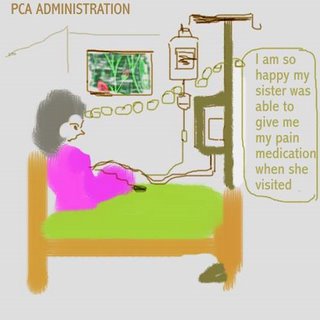


PCA ( Patient Controlled Analgesia)

Patient Controlled Analgesia may be ordered by
the doctor for the patient who is awake, alert and
able to self medicate. This method of administering
pain medication , is done via a pump, through the
intravenous route. Dosages are decided by the doctor.

However, patient and family teaching should be
included in the care plan. It is not uncommon for
family members to press the pain button for the
patient. Sessions 12 gives an overview of pain
assessment.

Indications for the use of the PCA pump include:
- patients who have surgical intervention
- patients with cancer or chronic pain issues
- conditions such as pancreatitis, sickle cell 
  anemia and more.


The Numerical Pain Scale is a useful tool when
assessing pain. It is based on a scale of 0-10.
A ladder starts from the ground and escalates to|
the highest point, so does pain start from 0-10.

It is important to do a pain assessment after pain
medication has been given. See image for more
information.


MALIGNANT HYPERTHERMIA

 Updated 3/24
 Dear nurses,

The Clinical Setting Step by Step is no longer available. Please 
click on the links below for updated information:
The purpose of anesthesia


Hope you had a good week. This week I have tried to simplify
Malignant hyperthermia. This is a rare, but life-threatening form
of hyperthermia.

Certain inhaled anesthetic gases like Halothane, Desflurane and
Sevoflurane may trigger this condition. Muscle relaxants like
Succinylcholine(Anectine)may also be responsible.


The standards of care are an essential part of  the
Nursing profession. It provides guidelines within a
framework of practices.
Learn more about : The standards of care

Learn more about : Nursing communication


PCA ( Patient Controlled Analgesia)

Patient Controlled Analgesia may be ordered by
the doctor for the patient who is awake, alert and
able to self medicate. This method of administering
pain medication , is done via a pump, through the
intravenous route. Dosages are decided by the doctor.

However, patient and family teaching should be
included in the care plan. It is not uncommon for
family members to press the pain button for the
patient. Sessions 12 gives an overview of pain
assessment.

Indications for the use of the PCA pump include:
- patients who have surgical intervention
- patients with cancer or chronic pain issues
- conditions such as pancreatitis, sickle cell 
  anemia and more.


The Numerical Pain Scale is a useful tool when
assessing pain. It is based on a scale of 0-10.
A ladder starts from the ground and escalates to|
the highest point, so does pain start from 0-10.

It is important to do a pain assessment after pain
medication has been given. See image for more
information.


Tuesday, April 13, 2010

PHARMACOLOGY FOR NURSES

Dear nurses,

If you would like to learn more about topics such as
Paralytic Ileus and Malignant Hyperthermia, simply
click on the link:
Pharmacology for Nurses-Chapter 5
and enjoy learning.

Wednesday, November 02, 2016

MEDICAL TERMINOLOGY IN THE CLINICAL SETTING - PART 1

Dear nurses,

Hope your week is going well. I wanted to
share with you a new video Sessions 62-
Medical terminology in the Clinical Setting.
 Topics include:
- DKA ( Diabetic Ketoacidosis )
- Hypothermia in the postoperative patient
- Malignant Hyperthermia its causes and treatment
So, just click on the link:
Medical terminology in the Clinical setting
and enjoy learning!


Learn more about : PACU

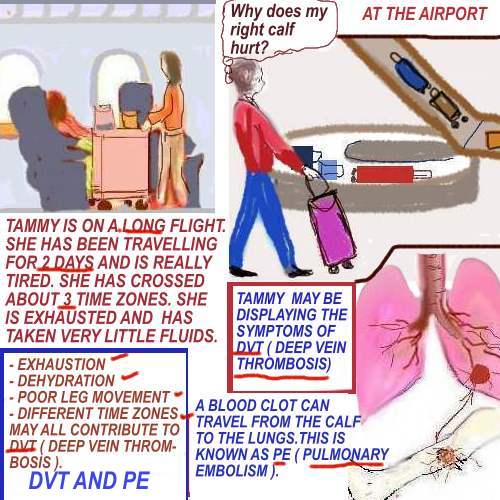
Most people who anticipate taking a long plane
 flight, may hardly stop to think about dehydration
 and its consequences. 
Learn more about : ARDS, DVT and PE


Learn more about : The Endocrine System


The standards of care are an essential part of  the
Nursing profession. It provides guidelines within a
framework of practices.
Learn more about : The standards of care

Learn more about : Nursing communication


PCA ( Patient Controlled Analgesia)

Patient Controlled Analgesia may be ordered by
the doctor for the patient who is awake, alert and
able to self medicate. This method of administering
pain medication , is done via a pump, through the
intravenous route. Dosages are decided by the doctor.

However, patient and family teaching should be
included in the care plan. It is not uncommon for
family members to press the pain button for the
patient. Sessions 12 gives an overview of pain
assessment.

Indications for the use of the PCA pump include:
- patients who have surgical intervention
- patients with cancer or chronic pain issues
- conditions such as pancreatitis, sickle cell 
  anemia and more.


The Numerical Pain Scale is a useful tool when
assessing pain. It is based on a scale of 0-10.
A ladder starts from the ground and escalates to|
the highest point, so does pain start from 0-10.

It is important to do a pain assessment after pain
medication has been given. See image for more
information.


Tuesday, September 09, 2008

THE POSTOPERATIVE PATIENT AND PACU

Updated 6/25

                                               
PACU ( Post Anesthesia Care Unit)

Following surgical intervention, a patient is transferred
to an area known as PACU. . Upon arrival, a nurse will
 reorient the patient to his surroundings and do an
 assessment. 

The nurse will also follow MD orders regarding: 
- monitoring vital signs and oxygen saturation,
- administer pain medication, replace IV fluids,
- check dressings at surgical sites for bleeding 
- check drainage tubes and carry out any other


What is an ileus?
 An ileus may develop in the postoperative patient,
 following abdominal surgery. It may also occur from
the use of narcotics.
The warning signs include: abdominal pain, distention
and absent bowel sounds.


Learn more about:
- DKA ( Diabetic Ketoacidosis )
- Hypothermia in the postoperative patient
- Malignant Hyperthermia its causes and treatment


Sunday, September 28, 2008

BRAIN TEASERS FOR NURSES AND MORE


Updated 9 /25

Dear nurses,
Stroke Series is no longer available.
See below for new information.

Here are some brain teasers:

Q -What is the normal distance for testing visual acuity?
A- 14-20 feet away.

Q - What does stereognosis mean?
A- The ability to identify objects by touching.

Q - What part of the brain is responsible for blance
and coordination?
A- The cerebellum, which lies below the cerebrum.

Q- What does word salad mean?
A- A collection of words that have no real meaning.

Q- What is anisocoria?
A- Unequal pupils which occur in about 20% of the 
population.

Learn more about: Why Therapy and The Aging Process


Please watch the video:  Sessions 62-
Medical terminology in the Clinical Setting.
 Topics include:
- DKA ( Diabetic Ketoacidosis )
- Hypothermia in the postoperative patient
- Malignant Hyperthermia its causes and treatment
So, just click on the link:
Medical terminology in the Clinical setting
and enjoy learning!


Learn more about : Stroke prevention

Monday, April 05, 2021

UNDERSTANDING ANAPHYLAXIS

Anaphylaxis is described as an allergic response 
to a substance. It is not always possible to predict
who will develop 
an allergic reaction. One thing
is clear, anaphylaxis is life- threatening. It requires
immediate intervention.

The immune system may show an unexpected response
 to certain substances. This may be medication, certain 
foods, bee stings, snake bite, food preservatives, certain
animals and more.


In the image above, there are three examples of an
allergic reaction 
occurring.
1) Ann was given contrast dye with her CAT scan,
This was ordered by the doctor. Shortly after, 
receiving
the dye, Ann complained of difficulty breathing.

2) A patient is complaining of swelling in the throat
after receiving an antibiotic.

3) A patient receiving a blood transfusion, is complaining
of shortness of breath and chills.

Epinephrine (EpiPen) is frequently used in the treatment
of anaphylaxis. Benadryl is sometimes ordered by the doctor,
prior to a blood transfusion, to prevent a possible reaction .

Learn more about: Malignant Hyperthermia