Dear Nurses

Thursday, November 22, 2007

HEPARIN THERAPY IN THE CLINICAL SETTING

Updated 6/25


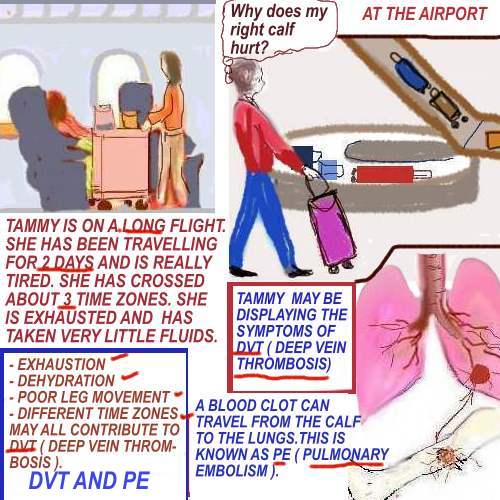
Learn more about : ARDS, DVT and PE

Learn more:Heparin Therapy


 In the image above, Lynn is a new graduate who
  is full of expectation. She arrives early on her new
  unit. But her hopes are shattered when her preceptor
  suggested that she is too busy to do an orientation.

It is unfortunate, but this does happen on occasion.
Although Lynn is off to a rough start, there are some
things she can do to make her situation easier.
Learn more by clicking on the links below:

HEPARIN THERAPY IN THE CLINICAL SETTING


Updated 4/25

Heparin is an anticoagulant drug. It is used
to prevent the formation of blood clots. It is
important to know what to look for, if the
patient  in your care is on anticoagulation
therapy. Learn more:


    Learn more about : ARDS, DVT and PE


Here are some diagnostic tests that are done frequently.

Follow the links below:

1. Chest X ray
2. CAT scan
3. EKG
4. MRI scan
5. Ultrasound
6. Echocardiogram


HEPARIN THERAPY IN THE CLINICAL SETTING


Updated 3/24
Dear nurses,
The Clinical Setting step by step is no longer available.
 Please click on the links for more updated information:
Over morning coffee

       
  A patient on Anticoagulation Therapy is at risk
for bleeding 
from the dressing site, gums, urine
 and more. It is important 
to include this in the
 Care Plan.


Here are some diagnostic tests that are done frequently.

Follow the links below:

1. Chest X ray
2. CAT scan
3. EKG
4. MRI scan
5. Ultrasound
6. Echocardiogram


Friday, November 16, 2007

HAPPY THANKSGIVING TO ALL NURSES- THERE IS MORE LEARNING!


Please enjoy the videos:
Sessions 38 - Happy Holiday


Learn more about: Herbs and spices

CARLA'S CLINICAL ASSESSMENT

Hi guys,
Hope you had a good week. Have you ever taken pills to a patient who could not respond ? Did you leave the pills at the bedside ? Or did you further assess the reason for unresponsiveness?
If you are unsure what to do, just click on the link :
STROKE SERIES -ASSESSMENT IN THE CLINICAL SETTING,
to learn more.

Friday, November 09, 2007

CRANIAL NERVE ASSESSMENT, TRIGEMINAL


Hi guys,

Hope you had a good week. CRANIAL NERVE ASSESSMENT IS a very useful tool when assessing a brain patient, regardless of where you work. Please CLICK ON the LINK at the side ( STROKE SERIES ASSESSMENT) and your questions will be answered.
HAVE A GREAT WEEK!


CRANIAL NERVE- 5, THE TRIGEMINAL

Saturday, November 03, 2007

STROKE - IDENTIFYING TYPES OF STROKE

Updated 1/26
Dear nurses,
Stroke Series Assessment is no longer available.

Scenario: In the image above, Sally is having a 
conversation with her neighbor Ann. Suddenly,
Ann notices Sally's speech is becoming garbled.

History: Sally is 56 years old and has been
complaining of intense headaches over the
last week. Ann called 911 and had Sally 
transferred to an Emergency Room nearby.

Below new topics and links have been added 
below. Enjoy learning!


Scenario : In the image a waitress is busy at work. 
She suddenly develops stroke symptoms. 

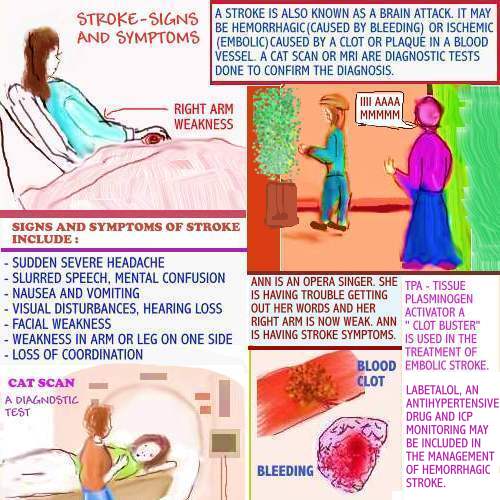
What is a stroke?
stroke is also known as a brain attack. It may be
hemorrhagic (caused by bleeding) or ischemic (embolic),
caused by a clot or plaque.

Can a stroke be prevented?
It is suggested that a stroke can be prevented. People who
smoke frequently, eat a diet rich in cholesterol foods and
do not exercise regularly, are considered to be at risk.

High blood pressure and obesity also puts someone at risk.
Lifestyle changes such as regular exercise, eating a diet with
fresh fruits and vegetables, as well as high fiber may help to
reduce stroke risk.

What does TBI mean ?

This means Traumatic Brain Injury. 
In the image below, a surfer hits his head on the pier.
He sustains a TBI and a Subarachnoid hemorrhage.


He was admitted to the ICU for treatment. An EVD was
placed by the doctor. Please click on the links for more
helpful information:
                                                    Medical abbreviations - Part 2
                                                       ICP for the layperson


Cranial nerves 3, 4 and 6 are responsible for extraocular
eye movements. All three pairs of nerves work together 
to create smooth movement of the muscles. they are
generally checked together.
Learn more about: Stroke assessment


STROKE- CRANIAL NERVE ASSESSMENT

Updated 1/26

Cranial nerve 5
The largest of the cranial nerves, is the Trigeminal.
                 This nerve contains three branches:
                Opthalmic ( corneal blink reflex). 
                           Maxillary - which supplies the upper jaw
                   Mandibular - controls the lower jaw.

Cranial nerve 7 - is the facial nerve , this is
checked with the trigeminal nerve.
Learn more about : The cranial nerves

Scenario: In the image above, Ann is an opera
singer. While on stage, she suddenly starts having
trouble getting her words out. Her right arm also
feels weak. These symptoms are classic of someone
experiencing a stroke.

Signs and stroke symptoms:
- sudden , severe headache
- slurred speech, mental confusion
nausea and vomiting
visual disturbances, hearing loss
- facial weakness

Enjoy the video: Anticoagulation therapy

Learn more about the effect of stroke on the 
cranial nerves : 

Please watch the video: ICP monitoring

Poor circulation may occur for a number of reasons.
The patient in heart failure, is at risk for stroke.


Myocardial infarction

A MI (myocardial infarction ) is also known as a heart
attack. It results from obstruction to blood flow. Fatty
deposits may cause this. 

Death of the heart muscle surrounding the obstructed
blood vessel will result. Symptoms such as lack of oxygen,
shortness of breath and chest pain will occur.

TPA

TPA ( Thrombolytic Plasminogen Activator) is
a " clot buster" that is used in the treatment of 
embolic stroke and myocardial infarction with
STEMI. 

TPA  is not without its side effects. Bleeding
particularly into the brain and at injection sites,
 seizures and possible anaphylaxis may occur.


STROKE - ACCURATE NEUROLOGICAL ASSESSMENT


Dear nurses,


Are you having trouble with your Clinical Assessment and Documentation when there is injury or insult to the brain after a STROKE ? Well, help is on the way! Just click on to the LINK:-"STROKE SERIES ASSESSMENT IN THE CLINICAL SETTING "and your questions will be answered in simple and humorous explanations.
Also visit dearnurses.com SESSIONS 2, 3, 25 &26

ENJOY LEARNING!