Dear Nurses

Tuesday, August 17, 2010

WHAT DOES IT MEAN ? NEUROLOGICAL VOCABULARY

Updated 8/26

Dear nurses,

Dearnurses.com is no longer available.
New information and links have been added below.

Basal skull fracture - What is it?
A basal skull fracture is usually diagnosed by CAT scan. 
It is very difficult to see on X-Ray. The image below,
shows what the patient with a basal skull may look like.

Basal skull fracture

It is important to be able to identify the signs of a basal
skull fracture.The crack in the base of the skull may cause
CSF ( cerebrospinal fluid) to leak from the nose or ear. 
A halo ring may appear on the pillow. Cranial nerves
may also be damaged.

 For more helpful information, please click on the links:


Here are some examples of neurological vocabulary:

Q -What is the normal distance for testing visual acuity?
A- 14-20 feet away.

Q - What does stereognosis mean?
A- The ability to identify objects by touching.

Q - What part of the brain is responsible for balance
and coordination?
A- The cerebellum, which lies below the cerebrum.

Q- What does word salad mean?
A- A collection of words that have no real meaning.

Q- What is anisocoria?
A- Unequal pupils which occur in about 20% of the 
population


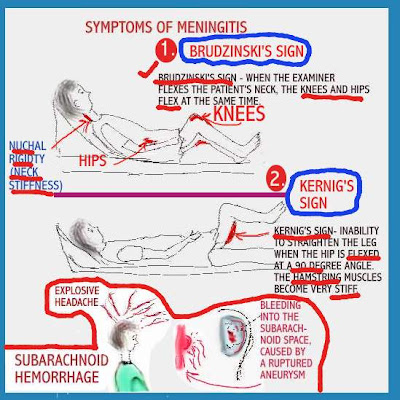
Brudzinski's and Kernig's signs are seen in patients
who have Meningitis or Subarachnoid hemorrhage.

Brudzinski's sign -When the examiner flexes the patient's
neck
, the knees and hips flex at the same time.
Kernig's sign - inability to straighten the leg when the 
hip is flexed at a 90 degree angle. The hamstring muscles
become very stiff.

 Medical abbreviations - Part 2

Learn more about : Stroke and ICP Monitoring

Here are some diagnostic tests that are done frequently.

Follow the links below:

1. Chest X ray
2. CAT scan
3. EKG
4. MRI scan
5. Ultrasound
6. Echocardiogram


Friday, December 28, 2007

BASAL SKULL FRACTURE


Updated 1/25
Dear nurses, 
Dearnurses.com is no longer available.Learn more about 
ICP monitoring by clicking on the link: ICP monitoring


Basal skull fractures are usually diagnosed by CAT scan. 
They are difficult to see on X-Ray. The image above,
shows what the patient with a basal skull may look like.


It is important to be able to identify the signs of a basal
skull fracture.The crack in the base of the skull may cause
CSF ( cerebrospinal fluid) to leak from the nose or ear. 
A halo ring may appear on the pillow. Cranial nerves
may also be damaged.

 For more helpful information, please click on the links:


SIMPLIFYING BASAL SKULL FRACTURE


Basal skull fractures are usually diagnosed by CAT scan.
They are difficult to see on X-Ray. The image above,
shows what the patient with a basal skull may look like.

It is important to be able to identify the signs of a basal
skull fracture.The crack in the base of the skull may cause
CSF ( cerebrospinal fluid) to leak from the nose or ear.
A halo ring may appear on the pillow. Cranial nerves
may also be damaged.

For more helpful information, please click on the links:
and enjoy learning. 
Updated 4 /23
Learn more about : Clinical judgement 

Friday, April 14, 2017

HAPPY EASTER TO ALL NURSES - ENJOY LEARNING


Updated 9/25

Dear nurses,

New topics have been added, for your learning
pleasure.

The brain is protected by the skull.
Injury to the brain may result in swelling.
The skull is made of solid bone and the
 brain has no room to expand when swelling
occurs.

 ICP Monitoring is done to reduce swelling 
and monitor brain pressures.The brain injured
 patient is at risk for seizures. This should be
reflected in the plan of care.
Learn more, by watching the videos:


Learn more about : ARDS, DVT and PE

Saturday, July 21, 2007

OVERVIEW OF CEREBRAL ANEURYSM

Updated 6/25


Learn more about :Subarachnoid hemorrhage
 

What is an aneurysm?
An aneurysm is a bulge or balloon in the wall of a blood vessel.
The majority of aortic aneurysms occur in the abdominal area,
but may also occur anywhere along the blood vessels that divide
after leaving  the abdominal aorta.

For more helpful information , just click on the link:


The brain is protected by the skull. Injury to the brain may
result in swelling. 
The skull is made of solid bone and the
brain has no room to expand when swelling 
occurs. 

ICP Monitoring is done to reduce swelling and monitor
brain pressures.
The brain injured patient is at risk for
 seizures. This should be reflected in the
plan of care. Learn more, by watching the videos:


.


Monday, June 12, 2006

ADDRESSING CEREBRAL ANEURYSM

Updated 8/23
Dear nurses,
Please click on the link below for updated information on this topic:
Subarachnoid hemorrhage and quiz
 _____


The brain is protected by the skull. Injury to the brain may
result in swelling. 
The skull is made of solid bone and the
brain has no room to expand when swelling 
occurs. 

ICP Monitoring is done to reduce swelling and monitor
brain pressures.
The brain injured patient is at risk for
 seizures. This should be reflected in the
plan of care. Learn more, by watching the videos:


.


Friday, October 19, 2007

SIMPLIFYING THE CRANIAL NERVES

Updated 1/26
Dear nurses,

Dearnurses.com is no longer available. 

It is important to recognize that, following 
a stroke or traumatic brain injury, a patient
may have damage to the cranial nerves.

Below, the cranial nerves are listed.
Additional topics of interest are also 
addressed.
.
                                 THE CRANIAL NERVES

Learn more about : Stroke Assessment 


Learn more about : Sepsis


Learn more about: Basal skull fracture

Saturday, January 11, 2014

CLINICAL SCENARIOS AND QUIZZES FOR NURSES


     CLINICAL SCENARIOS AND QUIZZES FOR NURSES
                         
Updated 6 /26
Dear nurses, 
Dearnurses.com is no longer available.
              
 A nurse whether experienced or new, may be presented
 with an unfamiliar work situation.These clinical scenarios
 are intended  to help nurses expand their learning curve.


  Here are some examples of situations a new nurse
  might face:
- working in the ER and caring for someone
   with a Le Forte fracture
-  a new nurse sent to work in the ICU and has a
    doctor's order to check Cranial nerves 3, 4 and 6
- a new nurse checking for a Halo ring after a basal
  skull fracture
- the doctor orders a Magnesium drip a patient is
   Many more topics and quizzes are included -
  Maternal, Cardiac and hormones 


A skiing accident and admission to ICU

In the image above, a skiing accident has occurred.
The injured person  is admitted to the ICU. ICP
monitoring has been set up. Family members have
arrived and cannot make sense of what is happening.

The staff members have not taken the time to explain
what has taken place.

When taking care of a patient who has experienced 
a traumatic event, the nurse should explain to the
family, what is being done. It may become necessary,
to get help from other staff members to help with 
communication.

Helpful suggestion:

Patient and family education should always
be included in the plan of care. The nurse is
responsible for initiating and updating the
care plan. 


Wednesday, January 11, 2012

ADDRESSING POSTPARTUM DEPRESSION

Dearnurses.net is no longer available.

Updated 6 /25

In the image above, a young mother has been
experiencing postpartum depression. She explains
to her doctor how she feels.

Some women experience postpartum depression 
after child birth, this may manifest as feeling sad,
tired and experiencing loss of appetite.

Suicide ideation may also occur. It is important
to seek medical help.

Causes include: hormonal changes, lack of rest,
family / financial issues and more.

It is suggested that eating a healthy diet, regular
exercise, psychotherapy and medications such as
antidepressants can help.

Suicide ideation

This condition may affect people of all different
age groups. It is important to seek medical help.

Enjoy watching the video:
Stress and its impact on the body

Addressing Psychotherapy

There are people who require mental health
therapy. They are the ones who become very
depressed or anxious and lose the ability to cope.

Examples are: the patient with OCD or Schizophrenia,
postpartum depression and more.

The pituitary gland

       The pituitary gland is part of the endocrine system. It is located 
  at the base of the skull in an area known as the sella turcica. 
Learn more about Hormones, by clicking on the link: Here
          

Thursday, June 11, 2009

UNDERSTANDING THE TRAUMA SCENE


Learn more, by clicking on the link below (SESSIONS 7):

Updated 8 /25

Dear nurses,

Have you ever wondered what happens at the trauma scene?
Have you ever taken care of a patient with a head injury or

Enjoy Learning!

Wednesday, June 29, 2016

WHAT HAPPENS WHEN HEAD TRAUMA OCCURS ?


       Enjoy the videos: Sessions 7 - Head trauma
       and ICP monitoring

Updated 10/25

Dear nurses,
New topics and links have been added below:
- trauma prevention


Learn more about : Neurological assessment


Learn more about: Triage